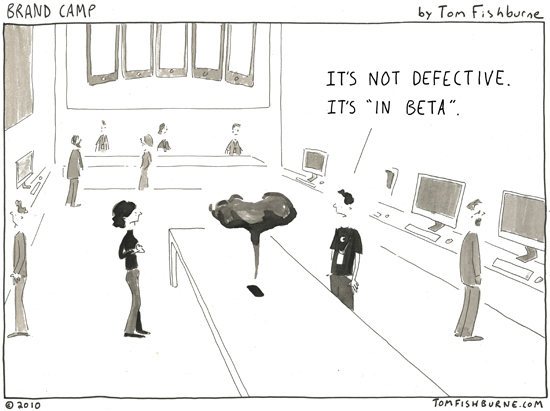
Beta releases used to be restricted to small groups of Beta testers. A Beta release allowed you to work out the bugs before a general market release. When a product shipped, it was considered final until the next release. Nowadays, many products are in perpetual Beta (and we’re all Beta testers). Gmail, Flickr and del.icio.us carry the Beta designation for years at a time as the products are developed and refined in the open. This creates a mindset of continuous improvement and treats users as co-developers. The pace of innovation happens so quickly that traditional release cycles don’t apply. This perpetual […]
Paid licensing options include a high-resolution download.
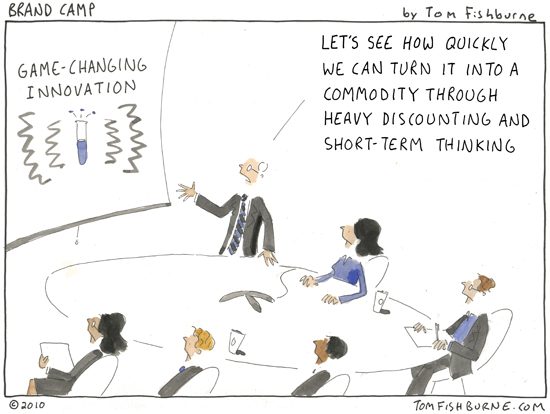
The very first Saturday Night Live in 1975 featured a mock-commercial with George Carlin making fun of the Gillette Trac II, which was the first two-blade razor. SNL spoofed it with a fake three-blade razor called the Triple-Trac, and closed with a tagline, “The Triple-Trac. Because You’ll Believe Anything”. Twenty-three years later, in 1998, Gillette launched the Mach3 razor, the first three-blade razor. I heard a Gillette executive give a talk about the Mach3 soon after launch, and he talked in gushing terms about the innovation. When it came time for questions, someone in the audience asked, “What’s next? 4 […]
Paid licensing options include a high-resolution download.
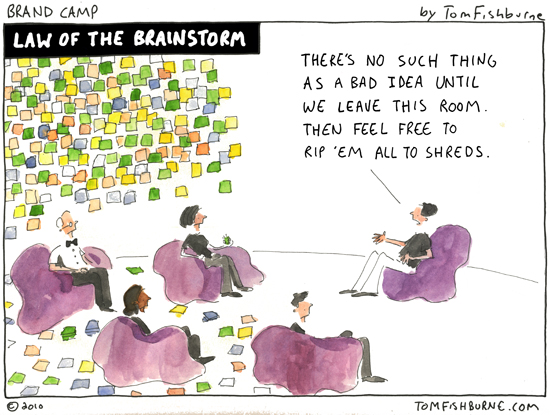
Last week I joined one of the better idea generation exercises I’ve experienced in a while. We split into small groups and toured the San Francisco Ferry Building to scout out retail merchandising ideas. The Ferry Building is packed with novel, funky shops like a Far West Fungi, which only sells mushrooms: dried mushrooms, fresh mushrooms, mushroom ice cream — everything conceivably mushroom-related except for the psychedelic variety. You can learn a lot from experimental retail concepts like that. As we debriefed afterwards, it struck me that the real challenge is the period after the brainstorm ends. When you distill […]
Paid licensing options include a high-resolution download.
We can thank adman Alex Osbourne for the Brainstorm (he’s the O in the agency BBDO). Alex invented the Brainstorm in 1939 as an alternative to the usual meetings of “discouragement and criticism which so often cramp imagination”. Alex Osbourne realized that an environment is needed where judgement is suspended and ideas have space to grow. As part of the attitude adjustment, Brainstorm facilitators run through the same set of stock Brainstorming rules: there’s no such thing as a bad idea, quantity counts over quality, encourage wild ideas, etc. These rules help attendees shift mental gears from their regular work state […]
Paid licensing options include a high-resolution download.
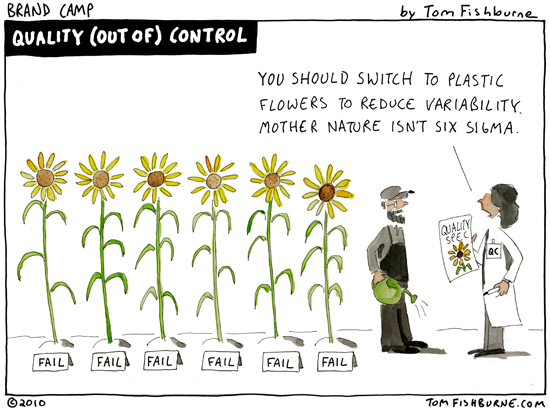
I’m enjoying Rework, the entrepreneurial handbook by Jason Fried and David Heinemeier Hanson, founders of 37signals. I was inspired to read it after meeting Mark Rohde, who drew all of the illustrations. One of the brilliant riffs in the book is titled, “Nobody likes plastic flowers”. Jason and David lobby for the beauty of imperfection and advocate the Japanese principle of wabi-sabi. They illustrate wabi-sabi with a wonderful quote by Leonard Koren: “Pare down to the essence, but don’t remove the poetry. Keep things clean and unencumbered, but don’t sterilize.” This flexible philosophy often conflicts with Quality Control, which prizes […]
Paid licensing options include a high-resolution download.
Most products are developed like a waterfall. Waterfall development is the classic sequential linear process where you finish one stage before moving on to the next one. You aim never to revisit a stage once you’ve finished it, so you’d better get that brief right the first time. When I worked in web development in the late 90’s, we adopted the waterfall process by default. We even hired a 30-year career military project manager who was an expert in waterfall development with construction projects like bridges. We could have wallpapered our offices with his Gantt charts. We discovered that this […]
Paid licensing options include a high-resolution download.
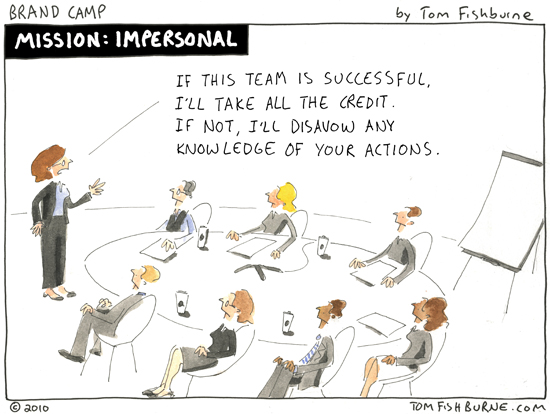
Last year, I heard Swedish axe maker Gabriel Branby speak at the DO Lectures. Gabriel’s company, Gränsfors, makes the finest forged axes in the world. He spoke about the essence of product development as craft. His company takes axe-making very personally. To underscore that commitment, each of his axes is forged by a smith who stamps his or her personal initials in the axe head next to the company logo. Contrast that sense of personal ownership with the professional detachment that is part of many forms of product development. Rarely is product development seen as craft. Most products launched are […]
Paid licensing options include a high-resolution download.
As Jerry Garcia once said, “You do not merely want to be considered the best of the best. You want to be the only ones who do what you do.” That quote was part of Rule #24 in Alan Webber‘s inspiring Rules of Thumb book, and partly inspired this cartoon (except I played with toes, not thumbs). The vast majority of innovations launched each year are “me too’s”. It’s very tempting to drive by the rear view mirror, with your eyes on the competition rather than on the consumer. I blogged a few months ago that companies can be classified […]
Paid licensing options include a high-resolution download.
I’m gearing up to speak at SXSW in Austin on Friday, so my mind is racing. My talk is called “Drawing Board: Innovation Lessons from Cartooning”. I’m sharing the many ways that cartoonists come up with ideas and find ways to break through the clutter. I think these lessons can apply to any form of innovation. Last week, I met a semi-retired cartoonist who once had his cartoon strip in 150 newspapers. I told him that I dreamed of someday cartooning full-time. He replied, “Are you kidding? How the hell could you do that nowadays?” I told him I certainly […]
Paid licensing options include a high-resolution download.
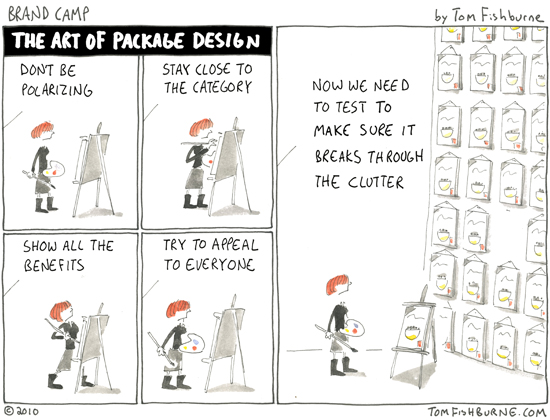
Working at method has taught me that package design is the single most important part of your marketing plan. Founder Eric Ryan likes to say that he views cutting steel as a marketing expense. Once a consumer told me that he buys method because the package design makes him want to lick the bottles. Remarkable design, whether in the store or in the consumer’s hand, makes every other aspect of marketing possible. Zero advertising on a remarkable product trumps heavy advertising on a mediocre product. Remarkable design implies that it’s fundamentally different from what is already on the shelf. That’s […]
Paid licensing options include a high-resolution download.
I’m gearing up to talk at SXSW in Austin in March. My topic is titled “Drawing Board: Innovation Lessons from Cartooning” and it’s loosely based on a few talks I gave last year about cartooning as a metaphor for innovation. Both activities involve coming up with ideas and bringing them to life. As I prepare for the talk, I’ve been thinking a lot about why so many new products are mediocre and uninspiring. I don’t think they result from a shortage of ideas. Instead, I think that the blame falls on the innovation process itself. Far more important than the […]
Paid licensing options include a high-resolution download.
Last year, business battened down the hatches and prepared for a hunger year. As I parodied in another cartoon at the time, a few companies with deep pockets used this opportunity to invest, but most companies cut back and slashed budgets. Some tightened their belts more than others. Budget cuts test to force priorities, and the immediate essentials usually trump the long-term. The innovation pipeline is often one of the first casualties. Innovation is the lifeblood of consumer products. Retailers are constantly hungry for new products and brands need to feed the beast or they risk losing space. Yet this […]
Paid licensing options include a high-resolution download.
I get most of my cartoon ideas in meetings. I was in a strategy discussion recently that became stuck in a competitive debate. We charted the minutia of each recent competitive action and overdosed on two-by-two matrices. In the middle of this war-gaming, someone observed, “We’re trying to drive by the rear view mirror.” It was a wake-up call that reminded us we were so focused on the competition, we had lost sight of the actual consumer. Sure, you need to know the competitive landscape. But others can only guide you so far. I most felt this competitive fever pitch in the […]
Paid licensing options include a high-resolution download.
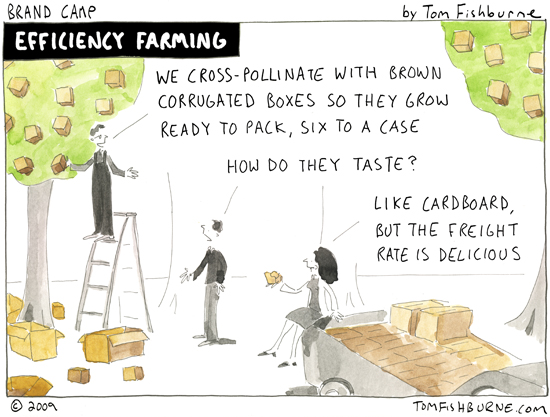
There’s constant pressure in business to make things as efficient as possible. In every project, the fat is trimmed, the edges are sanded, and the processes are streamlined. It’s how you bring scale to ideas. It’s how you improve margins over time. But far too often, the uniqueness of an idea gets lost in all the efficiency. I was reminded of this recently when evaluating a couple different bottle designs. One was incredibly unique and differentiated, but inefficient all the way through the supply chain to the retail shelf. Another was über-efficient, but, not surprisingly, too close to the rest […]
Paid licensing options include a high-resolution download.
I passed by a design studio last week that had jack-o-lanterns on the stoop. I like that an office of designers would spend time designing pumpkins. It struck me that jack-o-lantern carving could be a good metaphor for innovation. If we carved jack-o-lanterns the way we design products, we would probably carve by committee. And, whenever something is designed by committee, it’s in danger of “Feature Creep.” With “Feature Creep”, the idea gains extraneous features until the project loses focus and momentum. It becomes a peace treaty. By trying to appeal to everyone, it misses what it set out to […]
Paid licensing options include a high-resolution download.
This cartoon was partly inspired by my friend Paul at Idea Sandbox and his brilliant Idea Killer BINGO card. All businesses talk about the importance of innovation yet most struggle with it. I don’t think they suffer from a shortage of ideas. I think they suffer from an inability to recognize and grow the ideas once they have them. It’s far easier to block, water down, or sabotage an idea than it is to help it grow. That’s because more organizations are equipped with cutting tools than with growing tools. When I joined General Mills years ago, we held ideations […]
Paid licensing options include a high-resolution download.
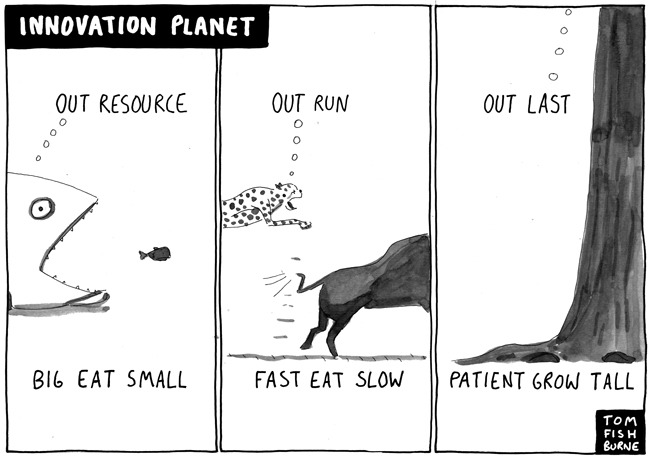
I've been thinking lately about the entrepreneurial anthem, "it's not the big that eat the small, it's the fast that eat the slow." I once did a field study with Fast Company magazine, which epitomized that sentiment. It was a year after the dot-com bubble popped, and they were facing a big identity crisis. They had been the quintessential handbook for the go-go late 90's after all. As part of the project, we interviewed 50 or so readers of the magazine. Most of the discussions turned up war stories from the late 90's around the dark side of "fast for […]
Paid licensing options include a high-resolution download.
I met Simon Clift a few weeks ago and he introduced me to the wonderful expression, "the abominable no-men". The longer the corporate ladder, the more people there are to veto or sandpaper an idea. And the harder becomes to usher an idea through the gauntlet unscathed. Simon is CMO at Unilever after 25 years there, so he knows all about this tendency in big business. But he also said that he was working hard to flatten things and push decision-making deeper into the organization. I later read this article, which quoted Simon at saying, "I'm not allowed near ads […]
Paid licensing options include a high-resolution download.
This cartoon isn't a critique of factories per se. Some of the sharpest people I've ever worked with have been factory engineers. Instead, this cartoon is about factory-thinking as a business metaphor. I just finished Seth Godin's new book on Tribes, where Seth frames the danger of being factory-centric as a business. Factories are designed to do the same repeatable tasks more efficiently and productively. Change and risk are strenuously avoided, and everyone follows instructions. But running the factory more efficiently won't help when the business itself is headed in the wrong direction. Seth argues that businesses need to embrace […]
Paid licensing options include a high-resolution download.
I originally started this cartoon as a series of panels on "recession survival tactics". I started thinking about different brands as "species" and I sketched a few panels with examples of how different brands approach the threat of recession: a turtle hiding in its protective shell, an ostrich with its head in the sand, etc. Then I started sketching a panel on "blending into the herd", and I realized this would be fun to draw as a full cartoon (I may draw the other "species" later). "Blending into the herd" feels like one of the most common responses to the recession. 2009 is […]
Paid licensing options include a high-resolution download.