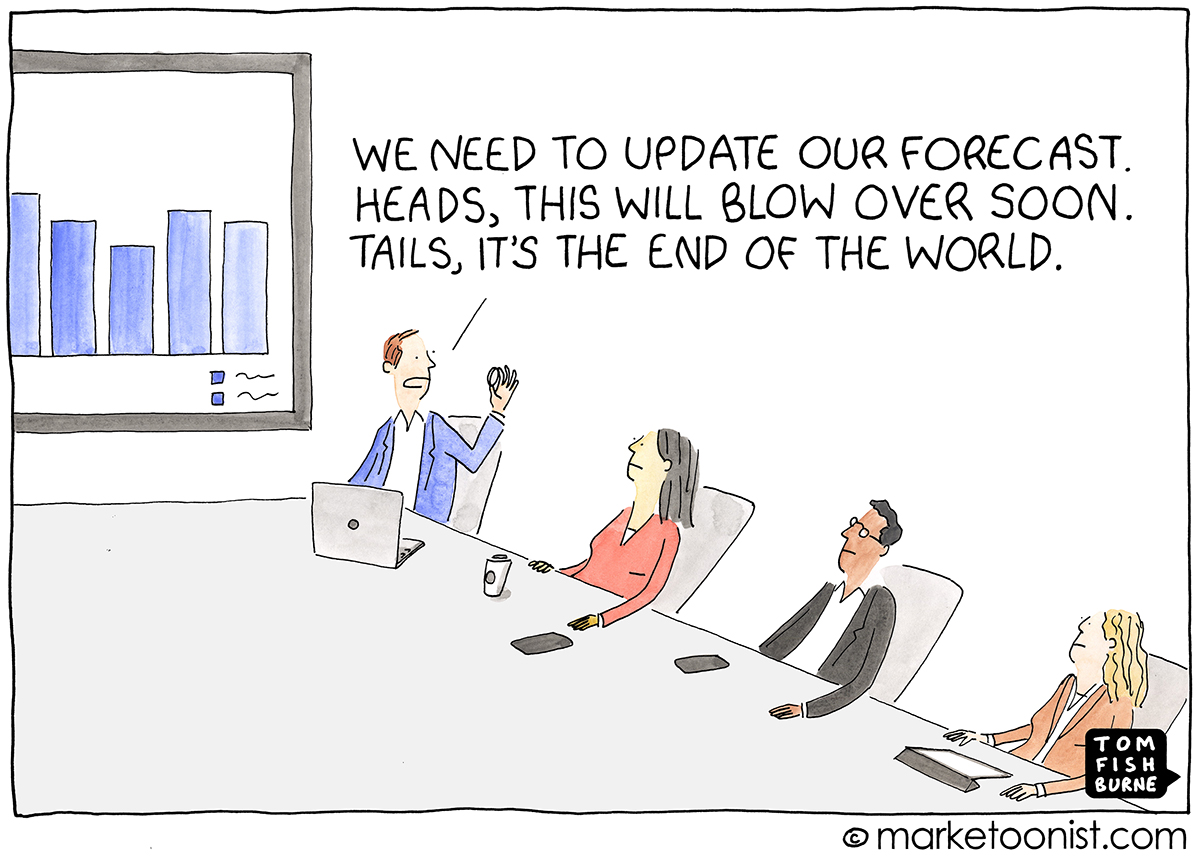
I love this observation by Adam Grant: “Confirmation bias is twisting the facts to fit your beliefs. Critical thinking is bending your beliefs to fit the facts. “Seeking the truth is not about validating the story in your head. It’s about rigorously vetting and accepting the story that matches the reality in the world.” In an increasingly data-driven world, we have to be wary of our biases and blind spots more than ever. There’s always data we can cherrypick and an echo chamber to listen to that will reinforce whatever we already believe. This is rampant in business and life. […]
Paid licensing options include a high-resolution download.
I’ve been hearing requests from some of you to draw a cartoon explicitly on the impact of tariffs — including one reader fresh from the Canton Fair (China’s largest trade show). Businesses of all sizes and geographies have been trying to estimate the potential impact. Last week, 3M estimated potential annual impact of $850 million and J&J $400 million. But the analysis is nonstop, the impact is more than financial, and we’re all a little blindfolded. McKinsey has an interesting framework for how to respond to tariffs, including the insight that companies consider “relative” competitive advantage. It’s not just about […]
Paid licensing options include a high-resolution download.
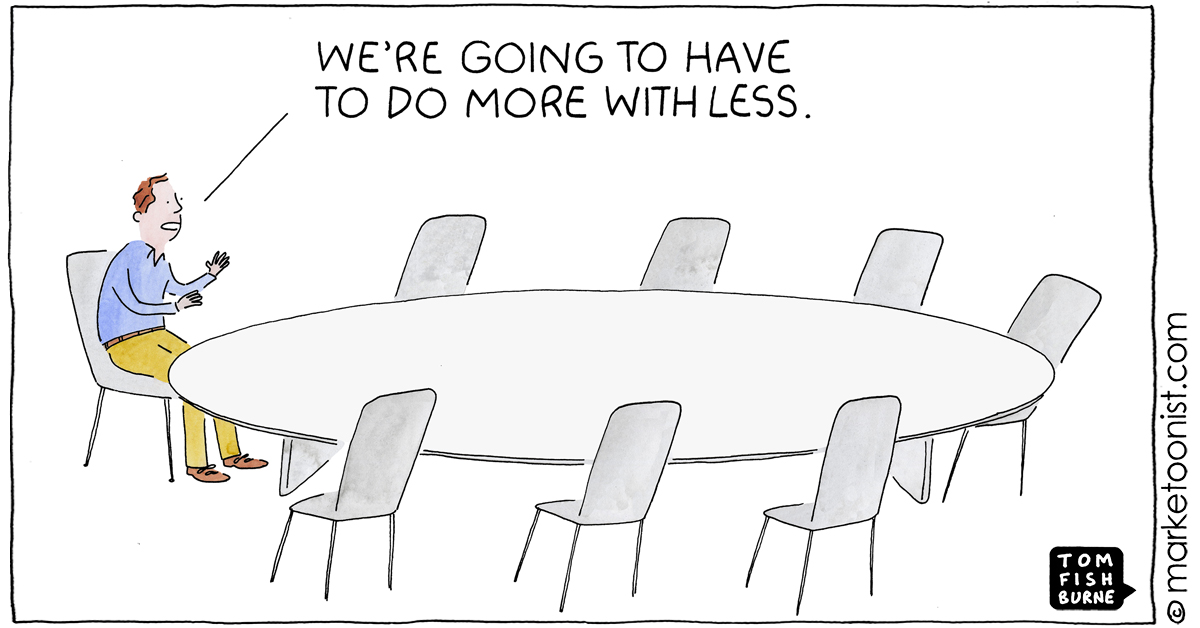
Doing “more with less” is emerging as a sort of business mantra for 2023. Microsoft CEO Satya Nadella used the term externally and internally this week to talk about the overall business climate. In a memo to staff announcing layoffs, he looked outward: “As we saw customers accelerate their digital spend during the pandemic, we’re now seeing them optimize their digital spend to do more with less.” Speaking later at Davos, he looked inward: “We in the tech industry will have to get more efficient — it’s not about everyone else doing more with less, we will have to […]
Paid licensing options include a high-resolution download.
Organizations have always struggled with making decisions. One McKinsey study found that more than half of all business time spent making decisions is ineffective. In an average Fortune 500 company, McKinsey estimated that decision paralysis cost $250 million of wasted labor costs per year. But decision paralysis is particularly acute in the face of an uncertain future. And decision making has been hampered even at the personal level as the pandemic reveals new surprises. The American Psychological Association found that 32% of adults (and 48% of Millennials) are “sometimes so stressed about the coronavirus pandemic that they struggle to make […]
Paid licensing options include a high-resolution download.
Team collaboration can be tricky in the best of times, but it will be interesting to see how completely virtual meetings will test this further — particularly when we add strained WiFi, the learning curve of more people learning new videoconferencing tools, and trying to juggle kids in the background. Videoconferencing technology has advanced (and kudos to Zoom for announcing on Friday they would offer free access to K-12 schools). But even the best videoconferencing technology can’t save unproductive meetings. As Bob Frisch and Cary Greene wrote in an HBR article this week: “As soon as one or two attendees […]
Paid licensing options include a high-resolution download.
“The worst thing to do in a time of chaos is add to it.” I found this quote from an article from Ogilvy on British brands reacting to the Brexit vote a few years ago. While Brexit isn’t a good corollary for what is happening now, I was reminded by this quote that we will periodically have to navigate times of extreme uncertainty. Every period of uncertainty is unique. But I find it helpful to remember that this too shall pass. Elsewhere in the Ogilvy piece, I found this quote: “With government sending only messages of confusion, brands can […]
Paid licensing options include a high-resolution download.
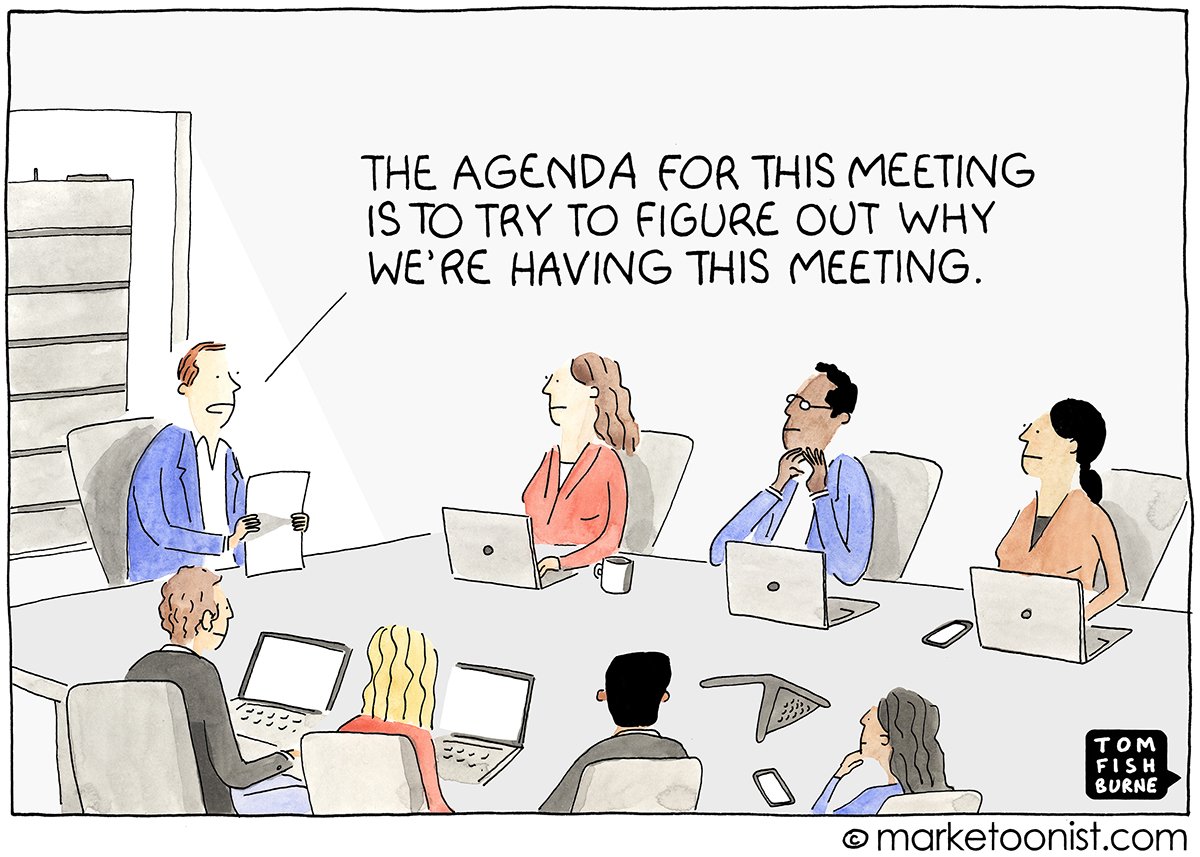
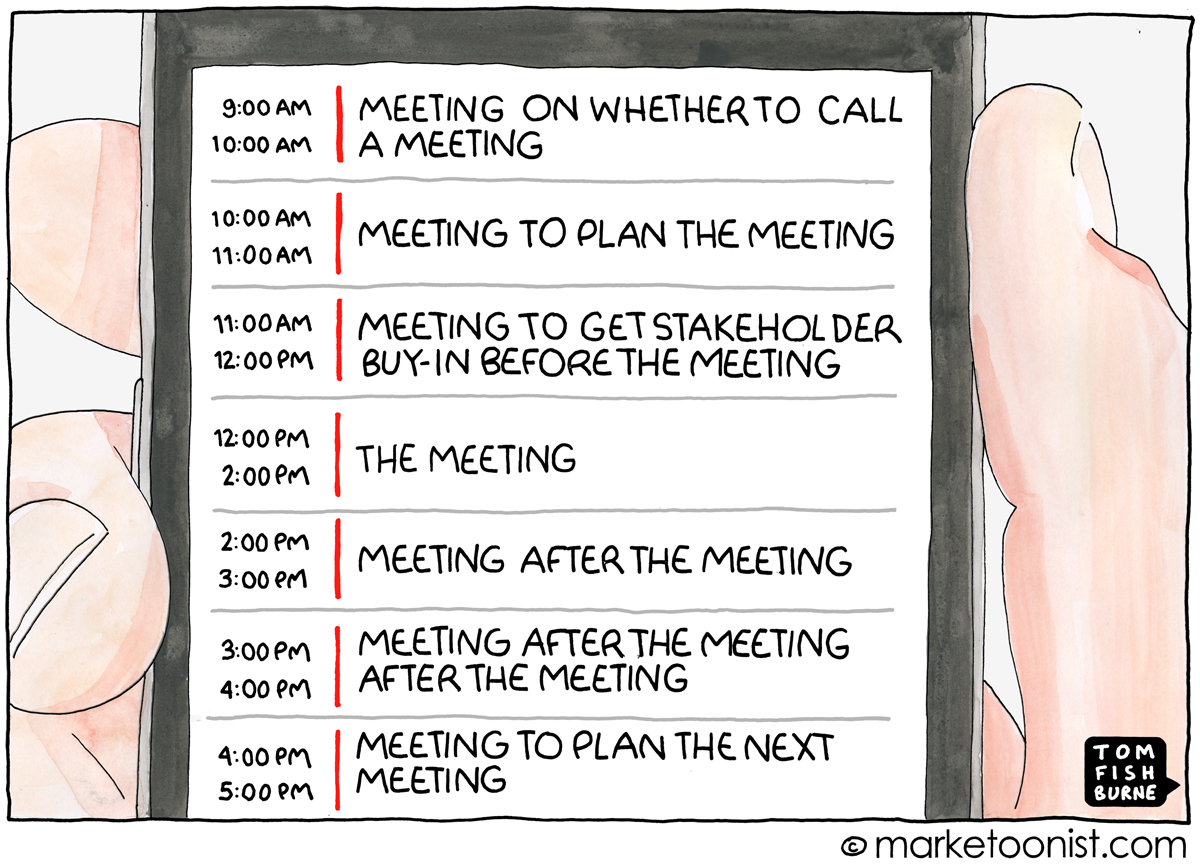
David Hieatt recently drafted a few internal principles he uses to create a culture of “Deep Work” at his company, Hiut Denim. The idea of Deep Work was famously coined by Cal Newport. Number one on David’s list is: “Protect you from meetings.” As he framed it to his team: “Most meetings are the result of lazy thinking. The problem is not even understood. So, no solution can be resolved. No clear action point is undertaken. So mostly it is an exercise of who has the nicest biscuits. If we call a meeting, it will be for a good reason.” […]
Paid licensing options include a high-resolution download.
In 1988, a Goodyear manager named Phil Ensor first coined the phrase “Functional Silo Syndrome” to describe organizational structure. He was inspired by the grain silos of his native rural Illinois, which reminded him of how departments, divisions, and geographies so often work in business — fragmented, insular, and sequestered. The “silo” term caught on. Jack Welch famously pioneered the idea of the “boundaryless organization” as way to topple organizational silos. He envisioned that the organization of the future would be transformed by the speed of globalization and technology and would need to operate differently. He instituted something called the […]
Paid licensing options include a high-resolution download.
I once heard Seth Godin give a talk to a group of marketers in London. After this session, someone asked his secret to being so productive. Seth not only publishes books and starts ventures, he famously finds the time to reply personally to every single email he receives. Seth replied simply, “I don’t watch TV and I don’t go to meetings.” That really resonated with me. I’ve worked in organizations where more than 75% of every calendar day was blocked with internal meetings. Seth has written extensively on the soul-sapping plague of internal meetings. Here is one of his classic […]
Paid licensing options include a high-resolution download.
This cartoon came out of a conversation with a marketer recently about the silos in her company. Her company was trying to encourage more collaboration across teams and divisions. They wrote values statements and held off-sites on the importance of cross-functional collaboration. At the same time, in the name of efficiency and cost controls, her company carefully calculated who spent time on which projects to a minute level of detail. That time was then billed back to the department leading the project. I get the efficiency argument and the difficulty of managing limited resources. But this company’s cost center emphasis […]
Paid licensing options include a high-resolution download.
The meeting after the meeting sometimes has more impact that the meeting itself. In many organizations, that’s where people share their real opinions and where the real decisions are made. A team might agree around the conference table, but then express doubts in the “safer” environment of the hallway or coffee shop. It’s a passive aggressive way to squash ideas, because the champion of the idea isn’t there to defend it. It can also be pretty toxic to an office culture. I’ve been working on a cartoon book idea about overcoming idea killers, and this meeting dynamic is one of […]
Paid licensing options include a high-resolution download.
“As a CMO, you get one shot, then you’re pushed out,” said Tony Pace, CMO at Subway. The tenure of the average Chief Marketing Officer has been increasing, but it’s still the shortest tenure of any executive role. As recently at 2006, the average CMO lasted only 23 months. Starbucks replaced their head of marketing five times in seven years. Coca-Cola replaced theirs four times in six years. FedEx Kinko’s changed theirs three times in five years. The average CEO lasts 8 years and the CFO lasts 10 years, but the CMO is out after 2-4 years. Why is there […]
Paid licensing options include a high-resolution download.
Apple and Microsoft both ousted executives in the last few weeks for abrasive management styles. Scott Forstall was Apple’s head of iOS software and Steven Sinofsky ran Windows. Both managers caused a lot of friction, but their approaches were overlooked for many years because they got results. The shakeups got me thinking about the management archetype of the “Brilliant Jerk”. Many organizations have this archetype. The big question is whether the brilliance outweighs the jerkiness. The classic defense of the Brilliant Jerk is Steve Jobs. The argument is that Apple’s products couldn’t be so single-minded and uncompromising without a dictator […]
Paid licensing options include a high-resolution download.
PowerPoint presentations may not have actually killed anyone, but they’ve sure killed many an idea. Our ideas are only as good as how we communicate them. Yet it is common to neuter ideas with mind-numbing slide presentations. We sometimes assume the longer and more verbose the slide deck, the more credibility our idea will have. I was struck by this quote from Steve Jobs, soon after he returned to Apple: “I hate the way people use slide presentations instead of thinking. People confront a problem by creating a presentation. I wanted them to engage, to hash things out at the […]
Paid licensing options include a high-resolution download.
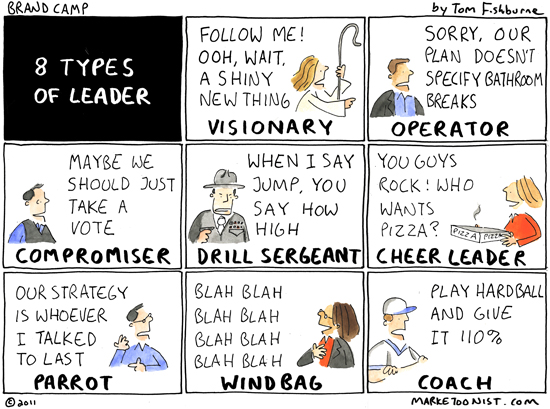
Last week I talked to a former Harvard Business School professor about leadership. He said he he was surprised how little leadership appears on the business school curriculum. Sure, there’s one required leadership class first year, but it’s often not taken as seriously as the other subjects. It is sometimes perceived as a soft, fuzzy, even unteachable, skill. Yet, leadership is the single most important thing we can do. Great leaders can move mountains. I’ve been fortunate to have known some great leaders in my career. Different leadership styles are needed in different situations. I like this footage of Twitter […]
Paid licensing options include a high-resolution download.
“All children are artists,” Pablo Picasso famously said. “The problem is how to remain an artist once he grows up.” As adults, I think we often forget how creative we are, and were. I taught a cartooning class last year to my daughter’s second grade class. When I asked the class who liked to be creative, every single kid raised their hand … enthusiastically. I was reminded of this when I taught a series of doodling workshops at the Do Lectures a couple weeks ago in Wales. Doodling is the simplest form of prototyping and idea exchange. People kept coming […]
Paid licensing options include a high-resolution download.
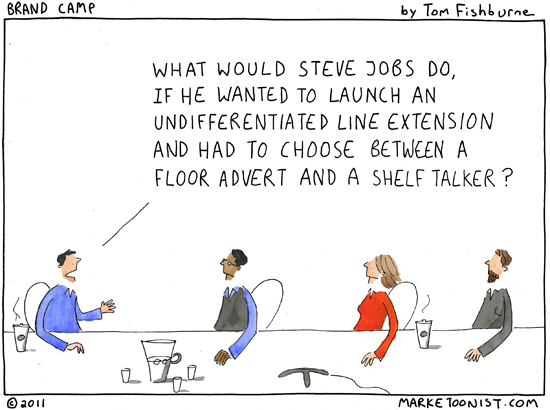
Following last week’s news, it is hard to overstate the impact of Steve Jobs on the business psyche. He is arguably the most mythic business leader of our time. It has become almost cliche to reference Apple in a presentation. Apple and Steve Jobs are used as inspiration in every imaginable industry and domain. Articles have referred to various entrepreneurs as the Steve Jobs of bicycles, of China, of meat (which is particularly funny because the real Steve doesn’t even eat meat). Businesses often ponder, “what would Steve do?” Yet what worked for Apple won’t necessarily work for you. It’s […]
Paid licensing options include a high-resolution download.
We often treat service as a cost center and promotions as a profit center. Yet amazing service can spread faster than any advertising and there can be a hidden cost from too many promotions. Years ago, I first discovered Utrecht, an art supply chain with stores usually staffed by artists. After an uncommonly helpful artist/salesperson helped me choose a set of technical pens, I became an advocate, and shared my experience with others. I signed up to receive emails and get a loyalty card. I even gave my main email address, rather than the one I reserve for “brands that […]
Paid licensing options include a high-resolution download.
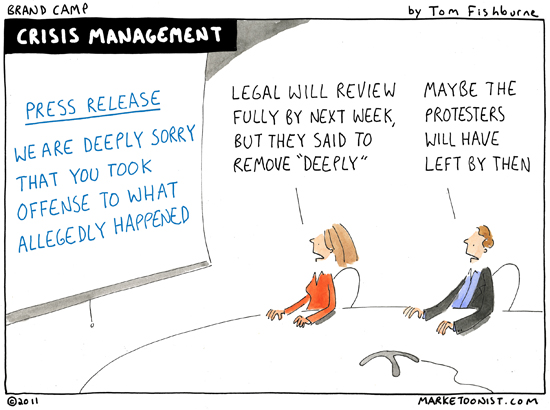
Crisis management may not be one of the 4 Ps, but it is every much a part of marketing. How a company deals with a crisis is a far greater litmus test for the brand than how it executes an advertising campaign. Yet often the loudest voice in the midst of a crisis is legal. Sure, a legal liability assessment is important. But, unchecked, a legal bias can lead to keeping too silent in a crisis, not admitting mistakes, and not showing empathy, the perfect storm for a PR disaster. 2010 was the year of crisis management, with BP, Toyota, […]
Paid licensing options include a high-resolution download.