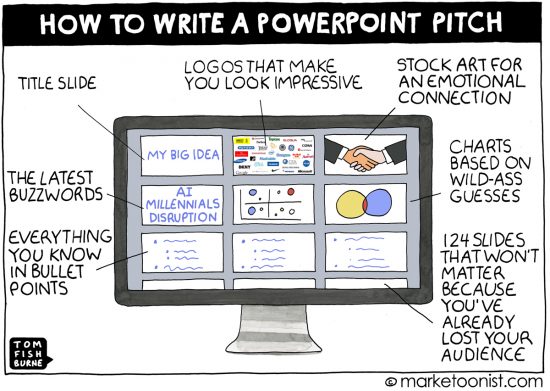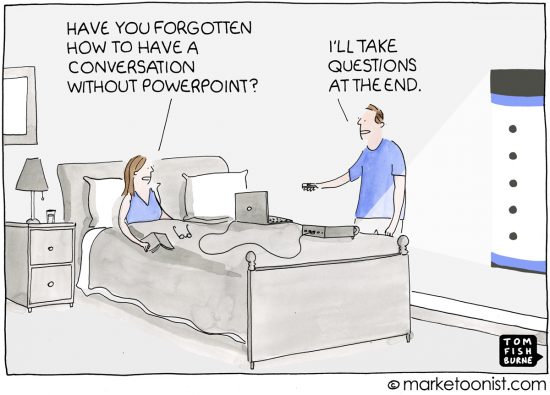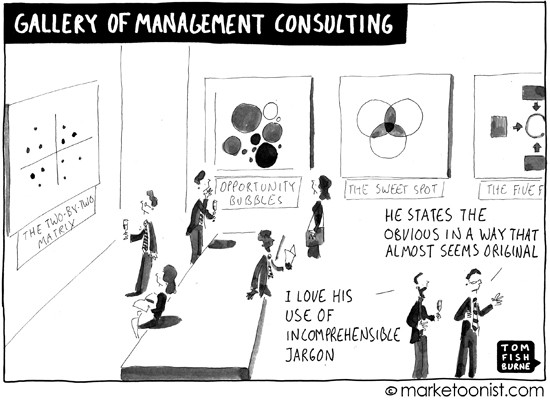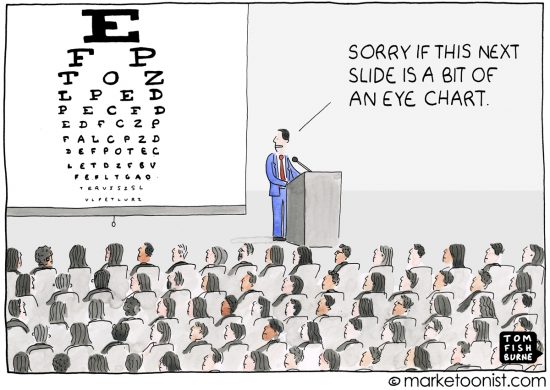


A few year ago, Mark Ritson wrote a handy guide to creating a marketing plan and critiqued those who make “PowerPoint decks by the yard.”
Mark wrote:
“Most marketing plans are PowerPoint presentations. Nothing wrong with that. But they are just too damned long – 50, 100, 200 slides in a plan. This is a shithouse way to present anything. It is symptomatic of global marketing teams with no practical experience of brand planning, who are just building PowerPoint decks by the yard. And it is indicative of marketing managers who have not thought long or choicefully enough about their plan.”
Mark instead advised a simple “three-part structure of diagnosis feeding strategy, which drives tactical choices.”
It’s easier than ever to generated PowerPoint decks by the yard. In one of the Super Bowl ads a couple weeks ago, Matthew Broderick used AI to say “finish this slide deck” and it was done.
And yet, work productivity isn’t only a measure of the volume of outputs. And when LLMs are trained on PowerPoint decks “by the yard,” the path of least resistance is just to generate more of the same.
In the HBR, Kate Niederhoffer, Alexi Robichaux and Jeffrey T. Hancock have been cautioning businesses on the negative effects of what they call “workslop”:
“As AI tools have proliferated in workplaces and pressure to use them has mounted, employees have had to contend with the scourge of workslop, or low-effort, AI-generated work that looks plausibly polished, but ends up wasting time and effort as it offloads cognitive work onto the recipient. For the person on the receiving end, it can be a confusing and infuriating experience.”
Ian Whitworth once described AI-generated content as “infinite words nobody wants.”
In making our Marketing Plans or any other type of work presentation, we have to be careful we’re not creating “infinite slides nobody wants.”
Here are a few related cartoons I’ve drawn over the years:
The signup form could not load. Subscribe here instead.