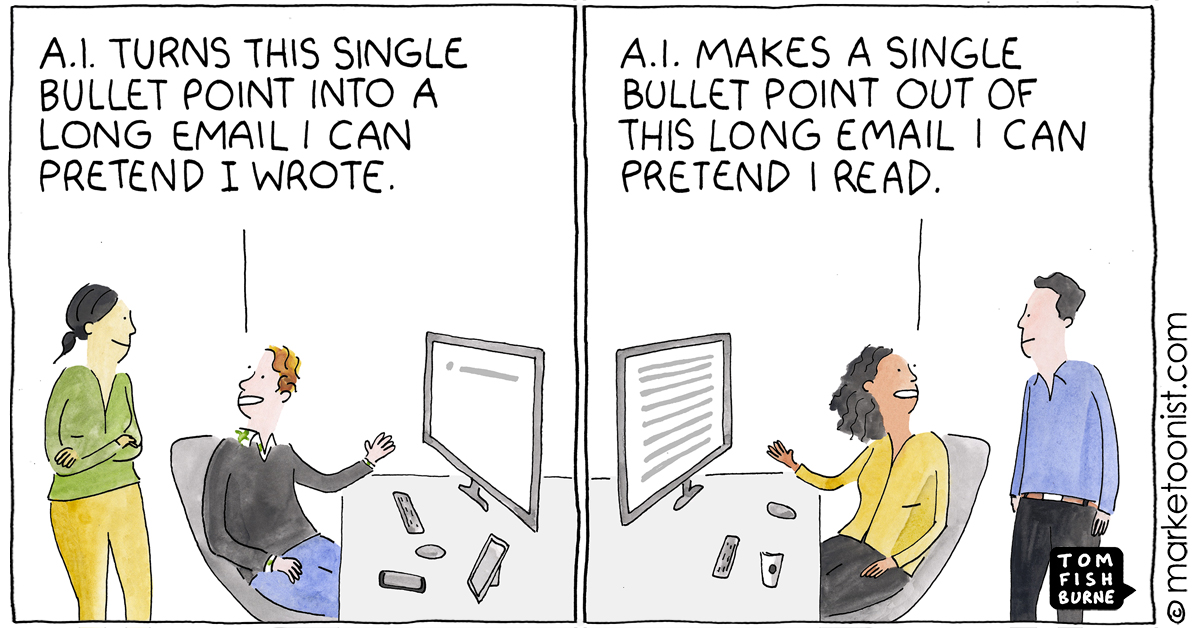
This week’s cartoon goes out to my friend Ann Handley, who has been putting up a valiant defense for the em dash (—).
As Ann put it recently:
“People are patrolling the streets, rounding up em dashes like it’s CSI: Grammar Unit.
“Use one in a paragraph? That means you’re secretly AI! You’re generating your LinkedIn posts with a boiling cauldron of vibes and predictive text! You’re a fake! A phony! Cue the pitchforks! Light the torches! The mob is lurching toward you!
“Meanwhile, the rest of us are just out here trying to write like actual humans—messy, rhythmic, gloriously imperfect.
“I just used an em dash in that last sentence, see? Like humans do.”
The Em Dash is just the tip of the spear for AI detection vigilanteism. In just the last few weeks, Hachette pulled a novel and The Atlantic called out a NYT column for tripping AI detection sensors.
The AI slop floodgates are wide open and the AI backlash is simultaneously underway. And as AI tools are more widely used, we’re in a murky period as a culture of figuring out where to draw the line and what to disclose.
The BBC recently counted 8 different initiatives to come up with an “AI-free,” modeled on the “Fair Trade” endorsement used for products. Claims like “Proudly Human”, “Human-made”, ‘”No A.I” and “AI-free” are popping up everywhere from films to books to marketing.
And yet, there’s no full agreement on how even to define “human made.”
As AI Research Scientist Sasha Luccioni put it:
“AI is now so ubiquitous and so integrated into different platforms and services, that it’s truly complicated to establish what ‘AI free’ means. From a technical perspective, it’s hard to implement. I think that AI is a spectrum, and we need more comprehensive certification systems, rather than a binary with AI/AI-free approach.”
In the meantime, it will likely be a bumpy ride.
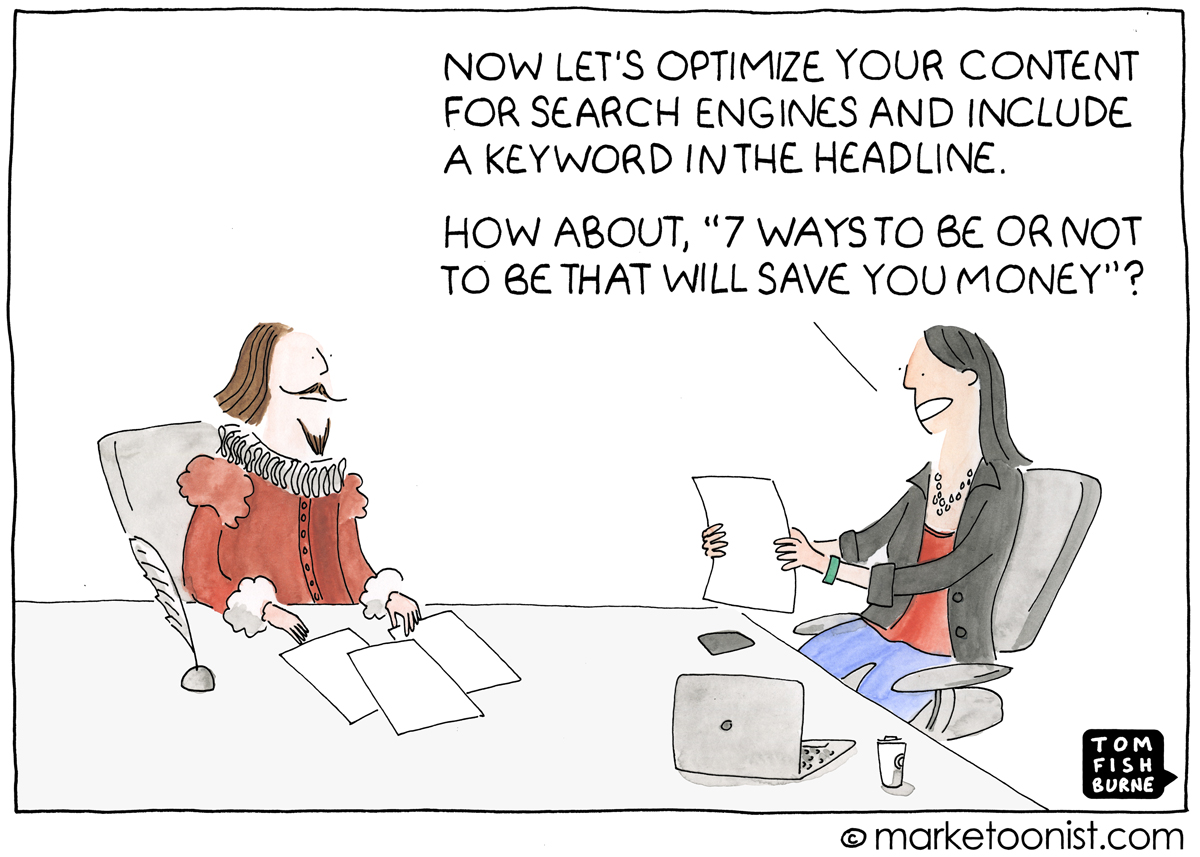
Here are a few related cartoons I’ve drawn over the years: