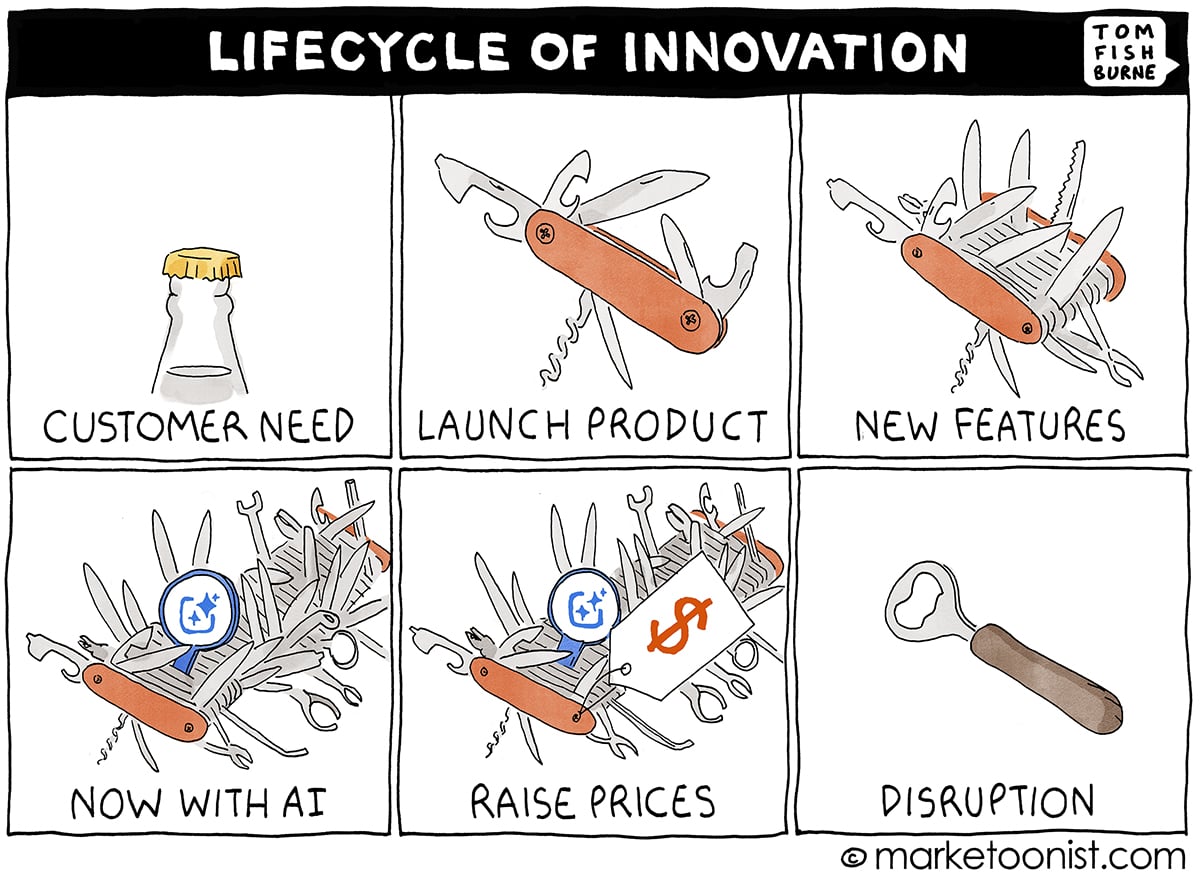
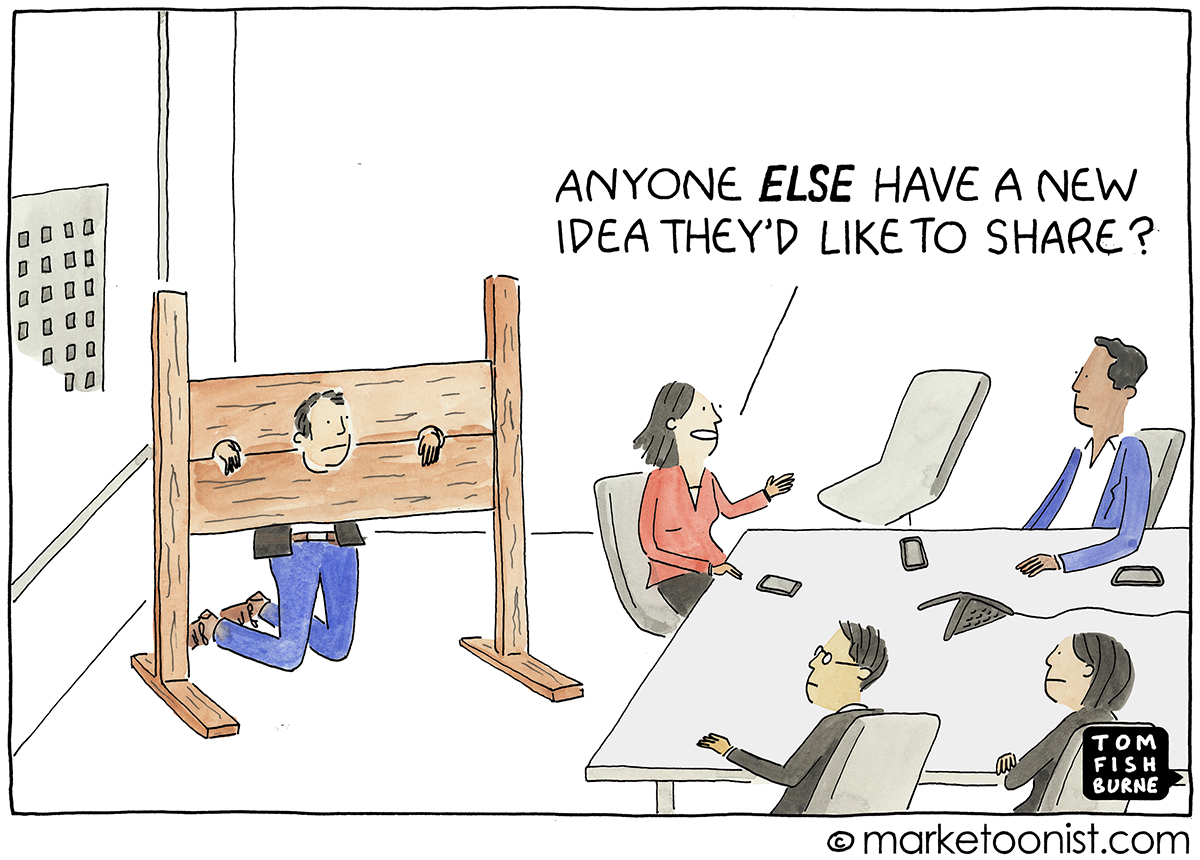
I drew this week’s cartoon thinking about two common innovation pitfalls: feature creep and over-serving the market. A company starts by meeting a customer need. Then it adds features to chase more profitable customers upmarket. Eventually it outstrips what the average customer needs or wants to pay for. A low-end disruptor comes along, and customers switch. Zoom is a classic case in point. When it launched, it disrupted bloated enterprise incumbents like Skype for Business or Cisco Webex. But Zoom has since become the bloated incumbent, rebranding as an “AI-first work platform” with an AI Companion, meeting summaries, and other […]
Paid licensing options include a high-resolution download.
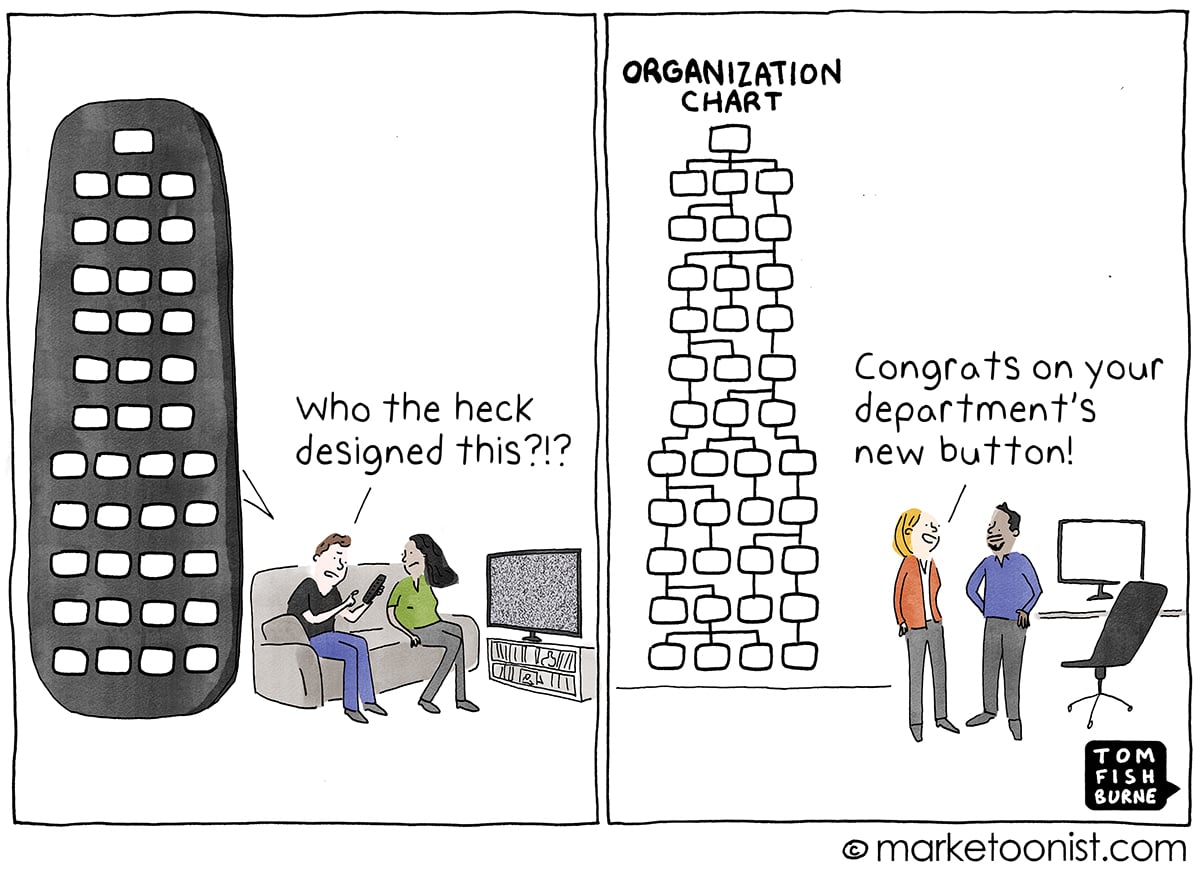
I heard somewhere years ago that the reason the classic TV remote control is so ridiculously complicated is that each button has its own product manager, lobbying hard for the features of that button. I think of that every time I stay in an Airbnb and can’t figure out how to turn on the TV. It inspired this cartoon. In 1967, a computer scientist named Melvin Conway introduced an idea that explains this phenomenon and system design in general. It eventually became known as Conway’s Law. In a piece titled “How Do Committees Invent?”, Conway observed that systems end up […]
Paid licensing options include a high-resolution download.
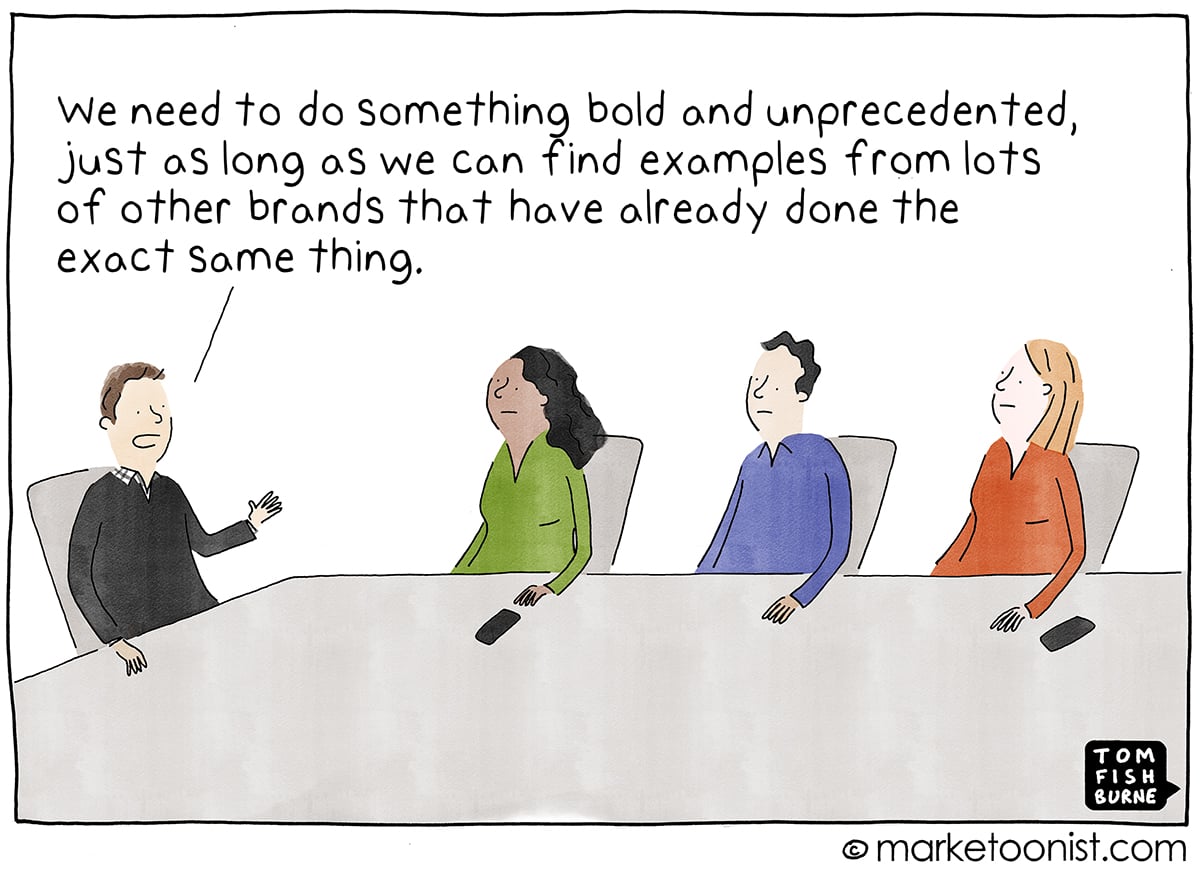
I drew this week’s cartoon on a paradox I keep seeing in innovation. Henry Ford famously said: “I invented nothing new. I simply assembled the discoveries of other men behind whom were centuries of work.” Ford’s original motor company cribbed ideas and inspiration everywhere from Singer sewing machines to P&G to Chicago slaughterhouses. Those borrowed innovations set the stage for a whole new approach to manufacturing. Stanford GSB professor Stefanos Zenios and Ken Favaro explored Ford’s approach as a case study in what they called “Precedents Thinking” in an HBR article last year. Their key thesis is that past innovation […]
Paid licensing options include a high-resolution download.
Many organizations use some form of an innovation funnel to bring ideas to life. It starts with lots of ideas at the front end and then launches whatever survives all the way to the back end. Yet this Darwinian process of bringing ideas to life doesn’t necessarily lead to survival of the fittest ideas. By design, the innovation funnel leads to survival of the safest ideas. Organizations are good at spotting risks. As ideas run the organizational gauntlet, they can get pruned, sheared, shaped, and watered down beyond recognition. On the way, they can lose the essence of the idea. […]
Paid licensing options include a high-resolution download.
One of the most popular cartoons I ever drew was about the Internet of Things, right after Google announced the acquisition of Nest in early 2014. “I think my Nest smoke alarm is going off,” one character tells another. “Google Adwords just pitched me a fire extinguisher and an offer for temporary housing.” iRobot later proved that truth is stranger than fiction when photos taken in homes by a beta version of its Roomba vacuum robot somehow ended up on Facebook in late 2022, including a photo of someone on the toilet. Yet the drumbeat to “Smartify” just about every […]
Paid licensing options include a high-resolution download.
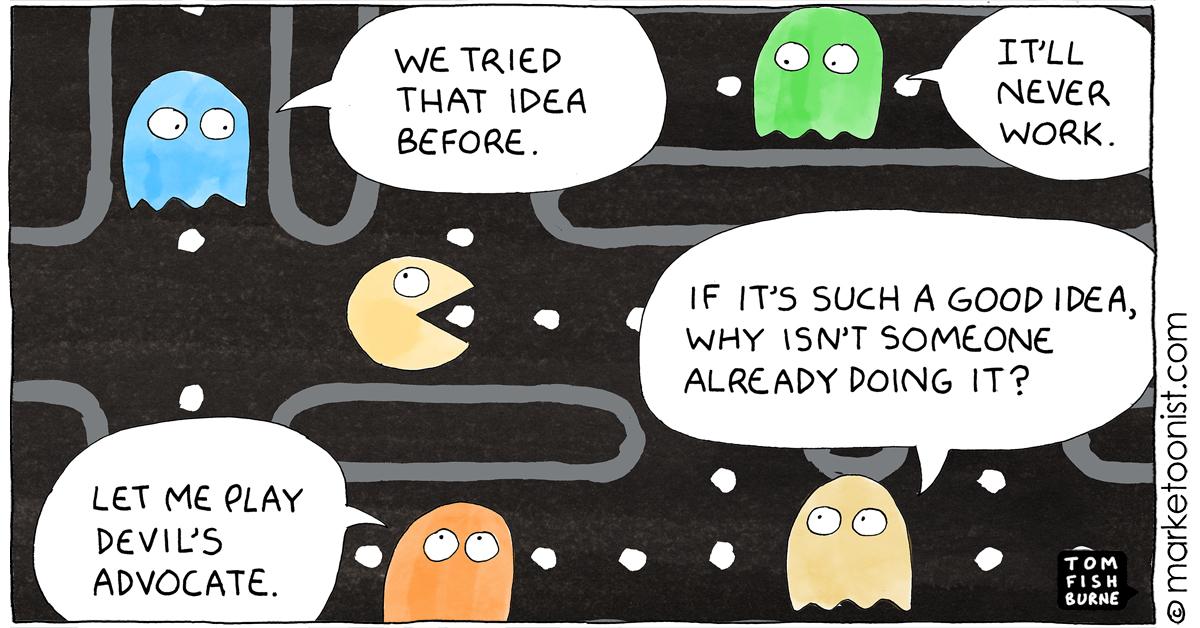
Disney alum Paul Williams once shared the brainstorming method developed by Walt Disney. Disney used to separate the act of coming up with and executing ideas into three distinct steps (and associated mindsets): The Dreamer, The Realist, and The Spoiler. As Paul wrote: “By compartmentalizing the stages, Walt didn’t let reality get in the way of the dream step. The realist was allowed to work without the harsh filter of a spoiler. And, the spoiler spends time examining a well-thought idea… something with a bit more structure. “When we brainstorm alone and in groups – too often – we tend […]
Paid licensing options include a high-resolution download.
A couple years ago, Cory Doctorow observed a phenomenon in online products and platforms that he dubbed “enshittification”: “Here is how platforms die: First, they are good to their users; then they abuse their users to make things better for their business customers; finally, they abuse those business customers to claw back all the value for themselves. Then, they die. “I call this enshittification, and it is a seemingly inevitable consequence arising from the combination of the ease of changing how a platform allocates value, combined with the nature of a “two-sided market,” where a platform sits between buyers and […]
Paid licensing options include a high-resolution download.
Product/Market Fit has emerged as a key threshold of success for startups, but the concept can apply to businesses of any size. First coined by Benchmark co-founder Andy Rachleff, Product/Market Fit was popularized by Marc Andreesen in 2007 in a famous essay titled “The Only Thing That Matters.” In the essay, Marc defined Product/Market Fit as “being in a good market with a product that can satisfy that market.” He added, “in a great market — a market with lots of real potential customers — the market pulls product out of the startup.” And yet, in practice, the “pull” that […]
Paid licensing options include a high-resolution download.
I’ve always liked this insight from Seth Godin: “If failure is not an option, then neither is success.” Organizations can spot the risks of a new idea a mile away. But there’s a curious blind spot when it comes to the risks of not taking those risks. The path of least resistance is to play it safe and keep as close to the tried-and-true as possible. I stumbled across an interesting HBR article from Bill Taylor called “Playing It Safe Is Riskier Than You Think”. In it, he writes about an analogy of risk first framed by two business professors […]
Paid licensing options include a high-resolution download.
Labeling an idea polarizing can be the quickest way to kill an idea. Businesses usually avoid ideas that are polarizing, whether new products or campaigns. It’s always easier to launch the next flavor of vanilla. But there’s power in polarization. By trying to appeal to everyone, you won’t necessarily appeal to anyone in particular. In a world of clutter, the last effect a brand can afford to create is indifference. Many product categories turn into a sea of sameness over time. But it’s hard to out-vanilla vanilla. Guy Kawasaki, chief evangelist of Canva and early Apple exec, once suggested: “Don’t […]
Paid licensing options include a high-resolution download.
I recently stumbled across this observation on innovation from Ger Perdisatt of Microsoft: “Often, companies talk a good game about innovation, but when these aspirations bump up against the realpolitik of running corporate organizations, there is typically only one winner: the status quo.” The pressure of the status quo is strong. Champions of innovation have to navigate a complex organizational maze to bring ideas to life. How we run that gauntlet makes a difference in the condition of the ideas at the end of the process. One challenge in creating a culture of innovation is that the mindset needed at […]
Paid licensing options include a high-resolution download.
I’ve drawn a few different cartoons over the years riffing on Geoffrey Moore’s 1991 classic, “Crossing the Chasm.” I once had the opportunity to give him the original of one of these when we spoke at the same Silicon Valley conference. Given the faddish nature of conventional wisdom in marketing, I particularly appreciate models like these that can stand the test of time. More than thirty years later, “Crossing the Chasm” is still essential reading for anyone working in entrepreneurial marketing. Crossing the Chasm is largely based on an even earlier theory of consumer adoption of innovation — Everrett […]
Paid licensing options include a high-resolution download.
The WSJ had a great feature last week on Chipotle and the “Keithadilla.” It was a fascinating case study on the state of innovation in the age of TikTok trends. In late 2022, a TikTok influencer named Keith Lee reinterpreted the Chipotle Quesadilla as an off-menu hack that included a DIY sauce combining Chipotle-Honey Vinaigrette and sour cream. Chipotle was soon overwhelmed by a surge of custom orders for the Keithadilla. The off-menu hack created a massive logistical challenge to Chipotle employees and their supply chain. Some staff refused to make it. But ultimately by February, just a few […]
Paid licensing options include a high-resolution download.
An entrepreneur friend of mine shared that one of the most invariable (and overused) questions he gets asked is what the “moats” are for his start-up. He described the question as a crutch that VCs go to when they don’t know what other questions to ask. As my friend put it: “More troubling is that they are looking for a silver bullet and training a generation of entrepreneurs to over optimize for a “silver bullet” vs. helping them build strong cultures. There is only one sustainable moat in my mind and that is culture. Anything else can be bought […]
Paid licensing options include a high-resolution download.
Most organizations use some version of an innovation funnel to bring ideas to life. It starts with lots of ideas at the front end and then launches whatever survives all the way to the back end. Yet this Darwinian process of bringing ideas to life doesn’t necessarily lead to survival of the fittest ideas. If we’re not careful, the innovation funnel leads to survival of the safest ideas. Organizations are good at spotting risks. In an effort to improve success rates, organizations tend to put sharper teeth in the funnel. As ideas run the organizational gauntlet, they can get […]
Paid licensing options include a high-resolution download.
A CB Insights study found that 35% of startups failed because they launched a product with no market need. It’s one of the main reasons cited why startups fail. As Sean Ellis, founding Dropbox marketer and “Hacking Growth” author, put it: “Scaling growth before having product/market fit is the fastest way to kill your startup.” Finding product/market fit (PMF) has become part of the standard VC checklist to evaluate new ideas. The concept of PMF originated with Sequoia founder Don Valentine and Benchmark co-founder Andy Rachleff, but was famously popularized by a16z co-founder Marc Andreessen in 2007. In a […]
Paid licensing options include a high-resolution download.
The design thinking methodology, pioneered and evangelized by fabled design firm IDEO, has spread from products to services to just about anything in business. “Design Thinking” has joined the corporate lexicon in a similar fashion as “Agile”. It means different things to different people and, too often, is used as shorthand for a magic potion approach to innovation and creative problem solving. No surprise that critics have piled on, perhaps most prominently with designer Natasha Jen’s article and talk a few years ago that “Design Thinking is Bullshit,” where she mocked design thinking for using “just one tool: 3M […]
Paid licensing options include a high-resolution download.
If the only constant is change, a close second is the resistance to that change. Bill Taylor, co-founder of Fast Company magazine, once stumbled across an obscure article written by a Product Manager in 1959 entitled “50 Reasons Why We Cannot Change.” The Product Manager, E.F. Borisch, compiled this list while working for the Milwaukee Gear Company, and many of the reasons still resonate as if they were written today: Reason #1: “We’ve never done it before.”Reason #4: “We tried it before.” Reason #7: “It won’t work in a small company.” Reason #8: “It won’t work in a large company.”Reason […]
Paid licensing options include a high-resolution download.
I was struck by this recent observation from Timothy Clark in his HBR article on cultivating “Intellectual Bravery”: “Intellectual bravery is a willingness to disagree, dissent, or challenge the status quo in a setting of social risk in which you could be embarrassed, marginalized, or punished in some way. When intellectual bravery disappears, organizations develop patterns of willful blindness. Bureaucracy buries boldness. Efficiency crushes creativity. From there, the status quo calcifies and stagnation sets in. “The responsibility for creating a culture of intellectual bravery lies in leadership. As a leader, you set the tone, create the vibe, and define the […]
Paid licensing options include a high-resolution download.
A Gartner study recently reported that more than half (57%) of CMOs expect to see a return to business as usual in the next 18-24 months. It made me think about what “business as usual” even means right now. Some aspects of how we work have changed so fundamentally, it’s hard to imagine that some of these changes aren’t permanent. I read somewhere that COVID is not so much forcing a change in business as it is accelerating a future that was already underway. For a few years, I’ve been hearing the managerial acronym VUCA (Volatility, Uncertainty, Complexity, and Ambiguity) […]
Paid licensing options include a high-resolution download.