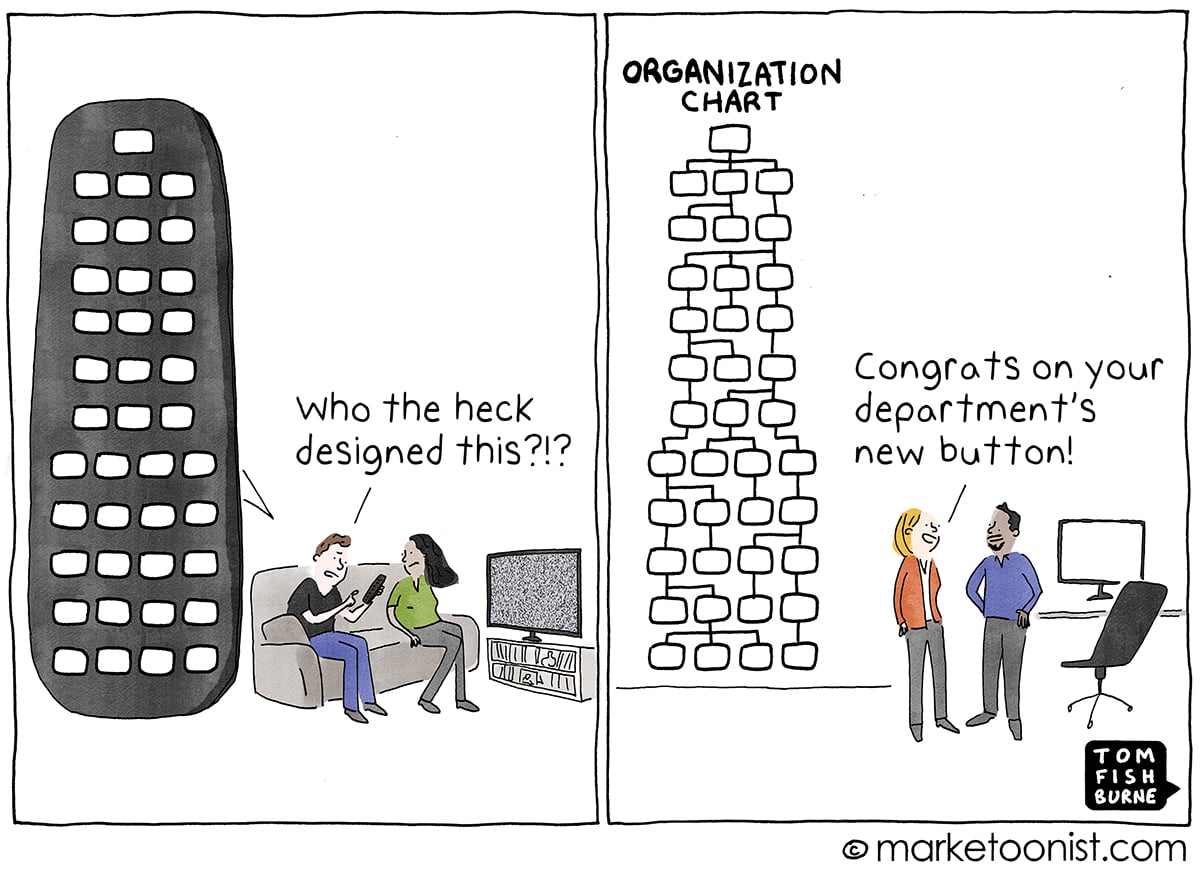
I heard somewhere years ago that the reason the classic TV remote control is so ridiculously complicated is that each button has its own product manager, lobbying hard for the features of that button. I think of that every time I stay in an Airbnb and can’t figure out how to turn on the TV. It inspired this cartoon.
In 1967, a computer scientist named Melvin Conway introduced an idea that explains this phenomenon and system design in general. It eventually became known as Conway’s Law.
In a piece titled “How Do Committees Invent?”, Conway observed that systems end up shaped like the organizations that designed them.
As Conway put it:
“Any organization that designs a system (defined broadly) will produce a design whose structure is a copy of the organization’s communication structure.”
In other words, whatever we make — products, customer experiences, system architectures — mirrors our own org charts.
Conway’s point wasn’t only about hierarchy. It was about how these different groups communicate. Every gap in communication becomes a gap in the product.
Our org structure is a design input, whether we treat it as one or not.
The dysfunctions of silo thinking show up directly in the products and services we make. And we’re often too close to notice.
When we do step back and look at our product experience the way customers do, the gaps we find tend to mirror the gaps in our own organizations.
Customers don’t care about the org chart. But they feel it when it shapes the product.
Here are a few related cartoons I’ve drawn over the years: