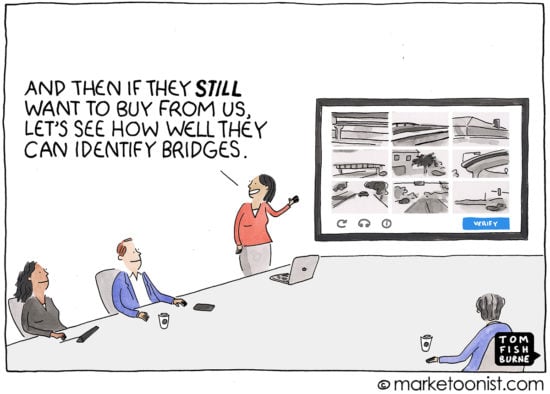


Recently I was nearly defeated by a restaurant mobile website. I somehow managed to fail a THIRD visual CAPTCHA puzzle asking me to identify something in a blurry image grid before I could order a burrito.
The next day, I chuckled at a news story describing a ChatGPT Agent that casually and successfully passed CAPTCHA as it narrated:
“Now I’ll click the ‘verify you are human’ checkbox to complete the verification on Cloudflare. This step is necessary to prove I’m not a bot and proceed with the action.”
I had a harder time proving that I was a human than the ChatGPT Agent did.
The CAPTCHA arms race has been accelerating for years. First invented in 1997, CAPTCHA is an acronym for “Completely Automated Public Turing test to tell Computers and Humans Apart.” At this point, AI is far better than humans at these tests.
Josh Dzieza once noted in The Verge:
“The problem with many of these tests isn’t necessarily that bots are too clever — it’s that humans suck at them. And it’s not that humans are dumb; it’s that humans are wildly diverse in language, culture, and experience.”
Security hurdles are inconvenient but necessary. Cybersecurity company Imperva reported that 51% of all 2024’s internet activity was bot-based.
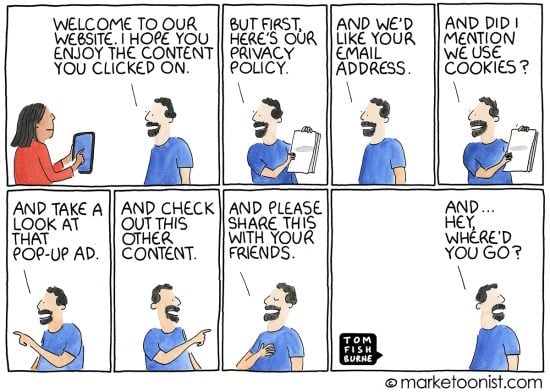
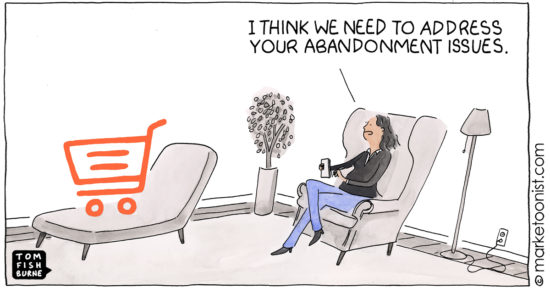
And yet any friction in customer experience carries a cost. Statista reported the 2024 global online shopping cart abandonment rate at 70%, with “complex checkout” cited as a major factor.
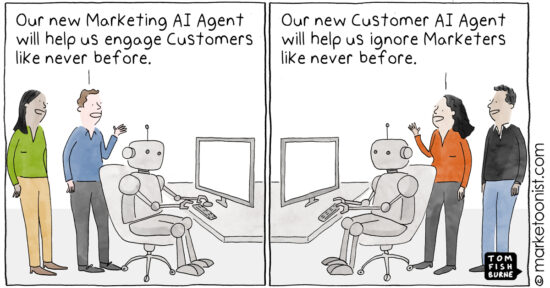
Agentic AI promises to bypass some of this friction, but it will be interesting to see how customer experience evolves.
And it’s more than a little ironic that the future may require bots to help navigate running a gauntlet designed to prove that we’re not bots.
Here are a few related cartoons I’ve drawn over the years:
The signup form could not load. Subscribe here instead.