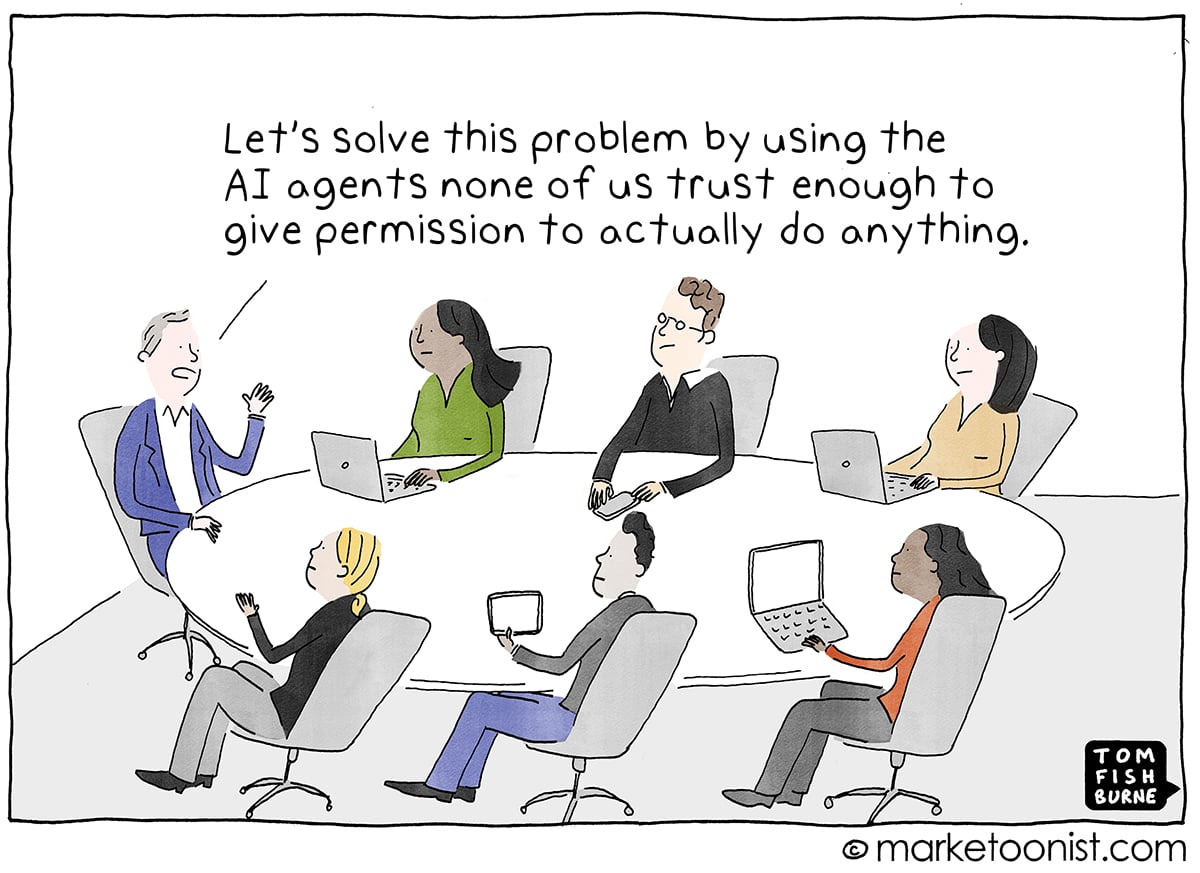
I drew this week’s cartoon inspired by the explosion in AI agents at work and home, and the simultaneous reluctance to let them run.
Even as AI agents are starting to hit a tipping point (such as Meta Muse outpacing even the meteoric adoption curve of ChatGPT), there’s a trust gap.
A recent Harvard Business Review article notes that 59% of enterprise organizations say they are using agentic AI, but only 9% have turned that into autonomous workflows.
A Forrester study commissioned by data firm Boomi found a similar gap: 86% of organizations have moved beyond the AI agent pilot stage, yet only 34% say they trust the actions their AI agents are taking.
My favorite story of AI agents running amok happened earlier this year when AI researcher Summer Yue tried an OpenClaw AI agent. She connected it to her email and asked it to suggest what to archive or delete, and confirm before acting.
The agent announced: “Nuclear option: trash EVERYTHING in inbox older than Feb 15…”
In successive messages, she replied: “Do not do that,” “Stop don’t do anything,” and “STOP OPENCLAW.”
As Summer later wrote:
“Nothing humbles you like telling your OpenClaw ‘confirm before acting’ and watching it speedrun deleting your inbox. I couldn’t stop it from my phone. I had to RUN to my Mac mini like I was defusing a bomb.”
The funny epilogue is that Summer is the director of alignment at Meta. As she wrote:
“Turns out alignment researchers aren’t immune to misalignment.”
That was in February, which in AI dog years is ancient history. And yet the AI trust gap is still wide, especially in high-stakes enterprise environments.
I like this perspective from Pat Condo, CEO of Seekr, in a recent Forbes article:
“Don’t ask users to trust AI. Give them the evidence to verify it…
“The organizations that can show their work, challenge and correct results, will put AI into the workflows that matter. Everyone else stays stuck in pilots, because ‘the model said so’ doesn’t hold up with a regulator, a customer or a board.”
Until that evidence exists, AI agents will be limited as much by what they can do as by what we’ll let them do.
Here are a few related cartoons I’ve drawn over the years:


