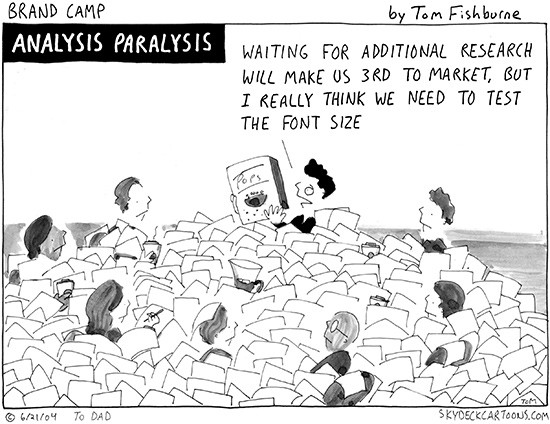

I’ve drawn a lot of cartoons over the years on the pitfalls of “analysis paralysis.” In one early cartoon from 2004, a manager at a conference table buried in reports says, “waiting for additional research will make us third to market, but I really think we need to test the font size.”
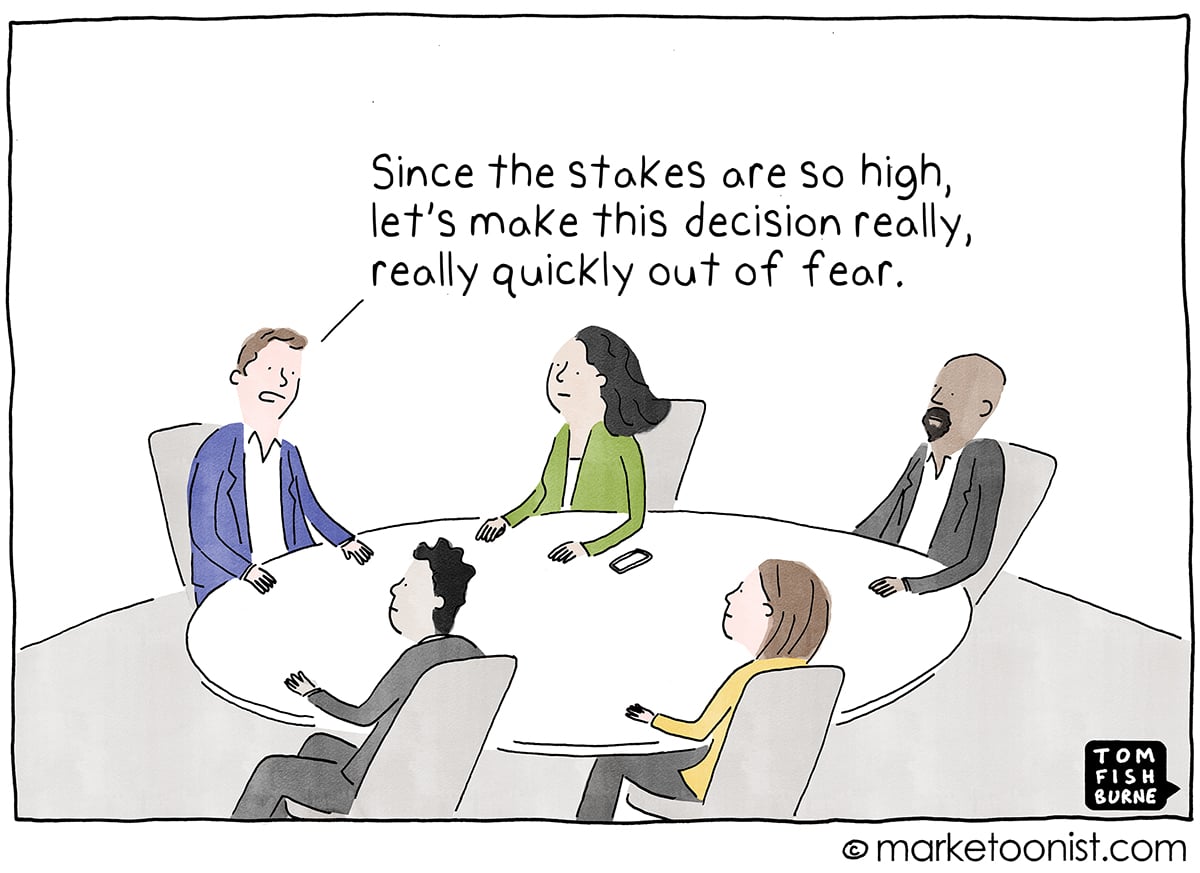
I drew this week’s cartoon on the other side of that same coin. Businesses tend to rush decisions when stakes are high and freeze when stakes are low, a pattern known as “threat rigidity.”
Berkeley’s Barry Staw and colleagues first described this pattern in 1981. Under stress, leaders tune out information, a form of “cognitive narrowing,” and concentrate control in fewer hands.
As Stanford organizational psychologist Bob Sutton framed it more recently:
“This narrowing and associated rigidity … is often maladaptive, because, during times of change, when being flexible and innovative is most adaptive, people, teams, and organizations are prone to freak out and freeze up.”
One antidote is Jeff Bezos’s famous distinction between one-way and two-way doors, from his Amazon shareholder letters. The key question in any decision is whether that decision is reversible. One-way doors can’t be undone and deserve deliberation. Two-way doors can be reversed and should be walked through quickly.
It’s common sense, yet businesses often apply a one-way door mentality to two-way door decisions. And vice versa.
Ultimately, fear is a poor judge of which door is which.