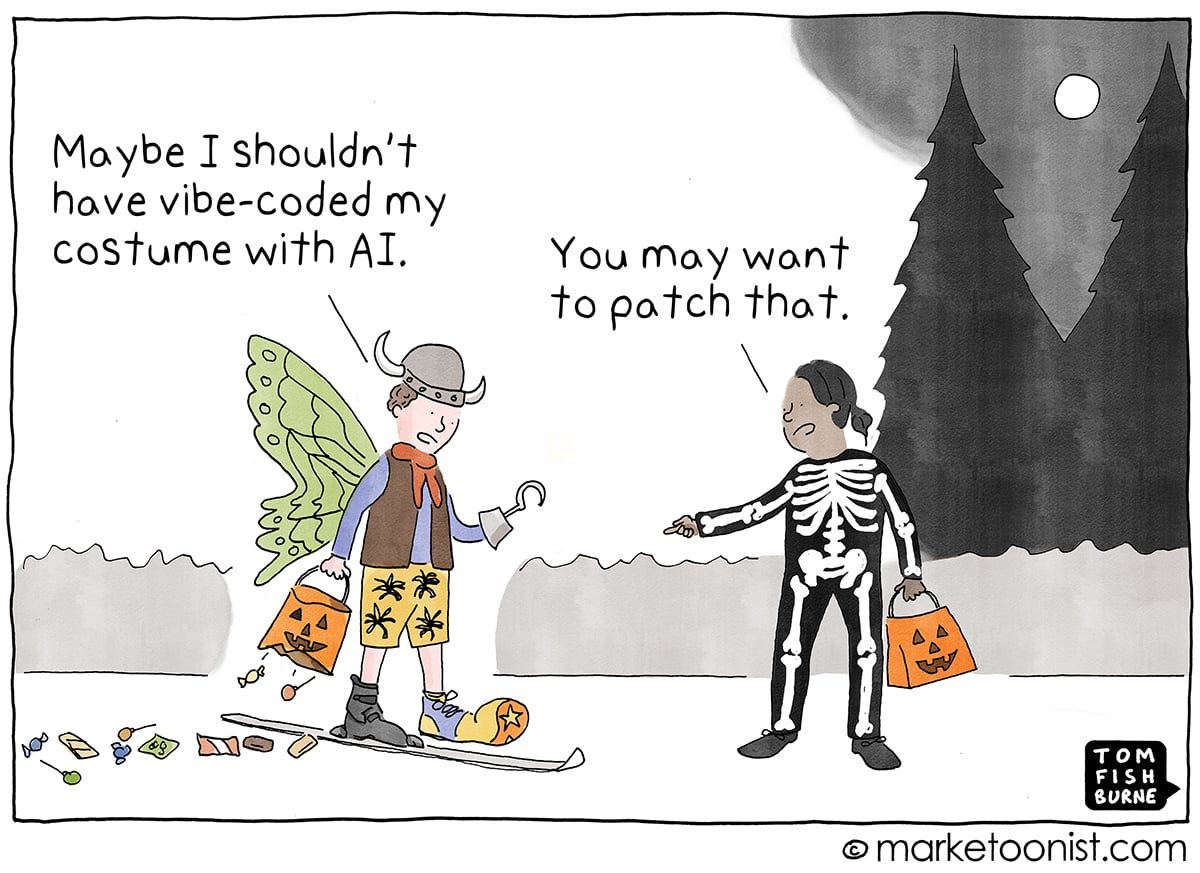
I drew this week’s cartoon thinking about the promise and pitfalls of “vibe coding.” Andrej Karpathy, OpenAI and Tesla AI alum, famously coined the term last year, defining it as “a new kind of coding … where you fully give in to the vibes … and forget that the code even exists.”
Last month Merriam-Webster announced it was adding “vibe coding” to the dictionary. Collins Dictionary named it their 2025 word of the year.
The idea of non-technical people building technical things is stirring up both panic and enthusiasm, depending on whose vibes we’re talking about.
The risks are real. In March 2025, a non-technical founder proudly posted that he’d built his SaaS app with “zero hand-written code.” Two days later, attackers were exploiting basic security holes. Within a week, the app was shut down.
It’s easy to imagine the pandemonium of skunkworks projects like that popping up in every corner of an organization.
But as my friend Scott Brinker found in his research with UserEvidence, the actual rise of vibe coding in marketing is not so scary. Most projects are contained and empowering marketers.
I love how Scott frames this, so I want to quote it at length:
“It’s a straw man argument. Nobody’s advocating for anarchy, blithely letting anyone build anything. Vibe coding can and should be done within guardrails and governance. Don’t be thrown by the ‘vibe’ language. It’s not the business operations equivalent of the free love movement. It’s people solving problems and innovating their work, using the latest tools of their trade. That’s exactly what we want people to be doing.
“‘But non-engineers can’t build good software!’ I call bull****. Sorry, but that blanket dismissal drives me nuts. First, most vibe-coded projects aren’t architecting the Eiffel Tower. They’re usually small, simple programs. Second, those builders know more about their domain — the problems to solve, the opportunities to seize — than any non-domain developer ever could, no matter how great of a software engineer they are.”
Scott also shares a quote from Airtable alum David Peterson that I’d never heard:
“When the person who feels the pain is also empowered to build the solution, the result is magical and utterly unique.”
Here are a few related cartoons I’ve drawn over the years:


