

In August 2011, Scott Brinker created the first official “Marketing Technology Landscape.” It was a supergraphic with logos of the 150 different marketing solutions in the market at the time.
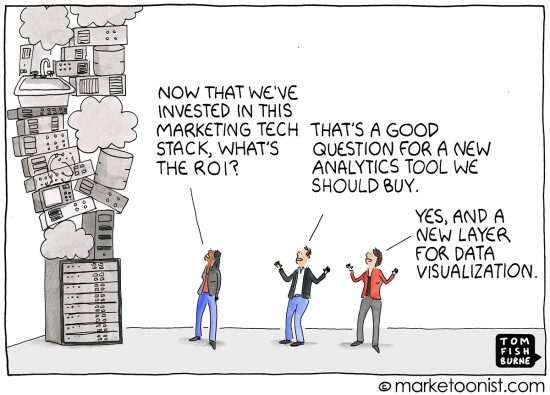
Scott continued mapping the landscape as the number of marketing technology solutions exploded — doubling to 350 in 2012 and blowing past 5,000 just five years later in 2017. I drew an “everything including the kitchen sink” cartoon in 2019 when the landscape reached 6,829 solutions.
The landscape has continue to expand further still. Scott’s latest 2025 Marketing Technology Landscape boasts a staggering 15,384 marketing technology solutions, organized in 49 categories. The logos are now so tiny, they look like pixels. The chart is completely unreadable. Of course AI is now part of many of these tools, and has accelerated the creation of new ones.

According to Zylo, a company that manages Saas licenses, the average business has a portfolio of 275 separate tools in their tech stack, many of those in marketing. Only 16% of the tools in a company’s tech stack were purchased by IT; 50% were purchased directly by the line of business and rest are shadow IT purchases.
The martech stack has become a Tower of Babel, with many of these tools not talking at all with the others.
Gartner reported in a recent CMO Spend Survey that marketing technology currently accounts for nearly a quarter (22.4%) of the total marketing budget.
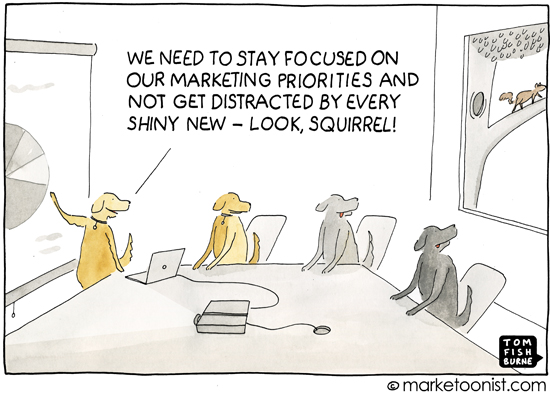
With so much focus on new technology, we can lose sight of the strategy. Ultimately, the technology is a means to an end.
I love how Scott defined Martec’s Law:
“Technology changes exponentially, organizations change logarithmically.”
Here are a few related cartoons I’ve drawn over the years:
The signup form could not load. Subscribe here instead.