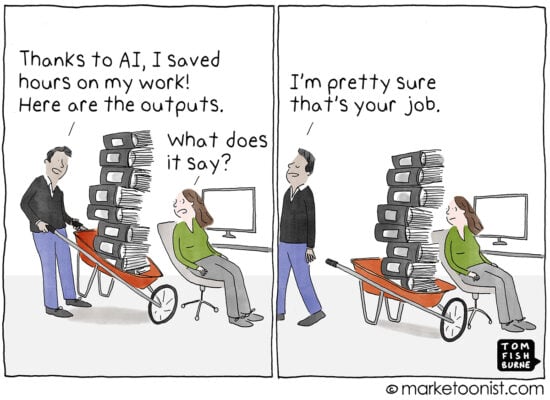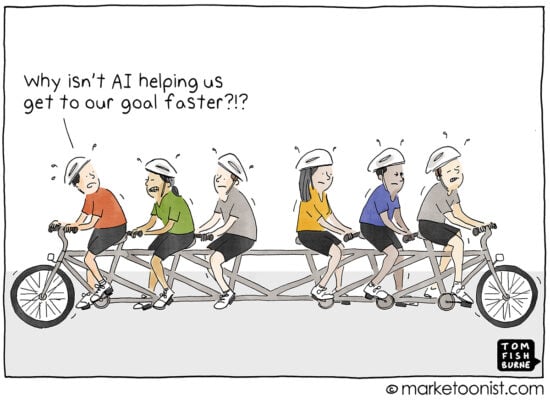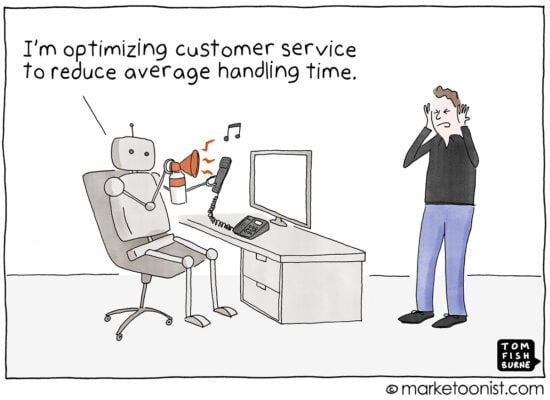

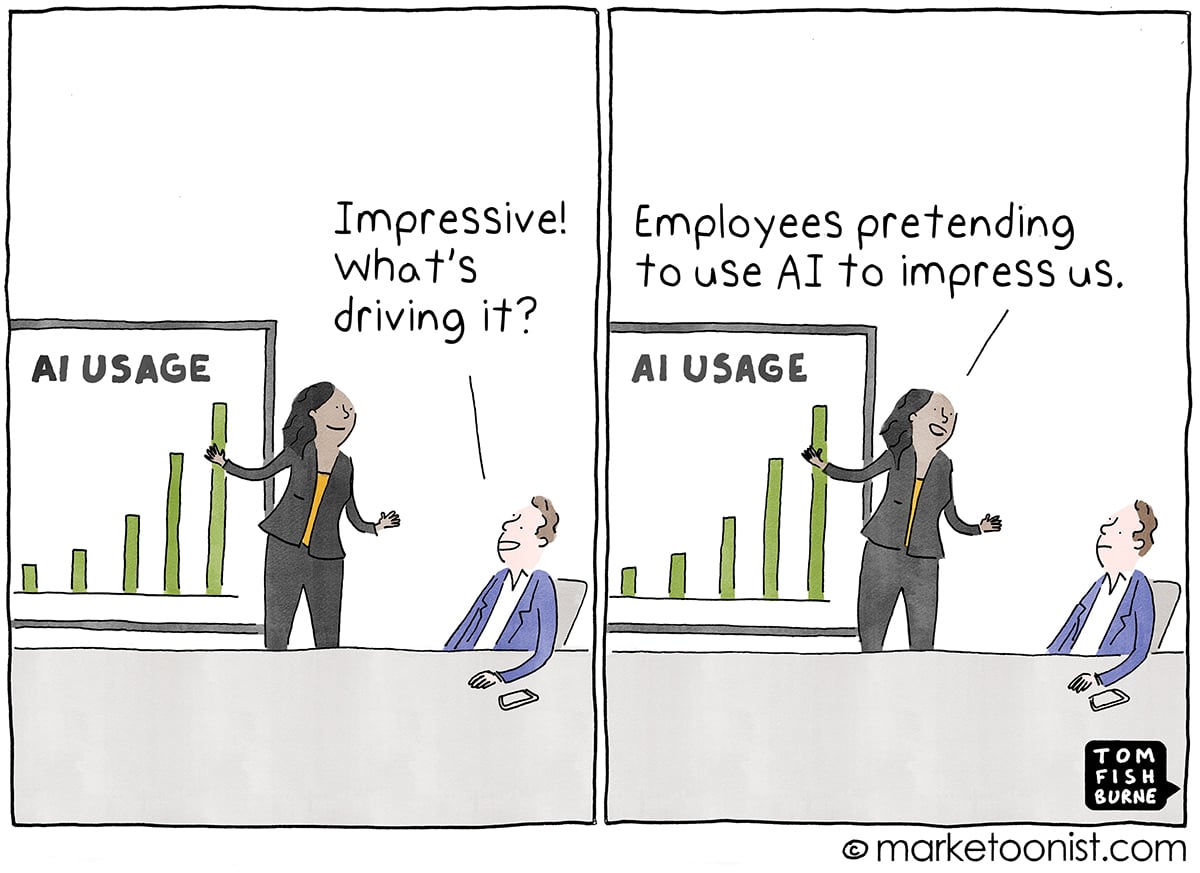
I drew this week’s cartoon inspired by new research on what can happen when companies push employees to “use AI.”
Workforce analytics firm Visier found that 48% of employees say they exaggerate their AI use or expertise at least some of the time. Visier calls this “performative AI.”
Trying to drive behavior change by measuring “usage” alone can reward the wrong behavior, like “tokenmaxxing.”
Earlier this year, Meta, Amazon, and Uber all had internal leaderboards ranking AI usage. Meta and Amazon both took theirs down. Some employees had been running AI agents for hours on busywork just to climb the rankings. Uber blew through their whole 2026 AI coding budget in four months.
A few months ago, I wrote about the lessons of the 50-year-old Goodhart’s law, popularized as:
“When a measure becomes a target, it ceases to be a good measure.”
Around the same time as Goodhart, psychologist Donald Campbell made a related point about the distorting effects of measurement, in what became known as Campbell’s law:
“The more any quantitative social indicator is used for social decision-making, the more subject it will be to corruption pressures and the more apt it will be to distort and corrupt the social processes it is intended to monitor.”
Last week, Amazon published an internal memo, walking back how they measure AI usage:
“We are all aware of how deeply flawed these metrics are, primarily because they are disconnected from what matters.”
The memo adds:
“If your work does not benefit from current AI tooling, that is a finding, not a failing.”
The signup form could not load. Subscribe here instead.